Showing posts with label running. Show all posts

Tuesday, October 28, 2014

Phone ArmBand

Carrying my phone on a run is non-negotiatble with me.  I'm making calls on low HR runs, listening to audiobooks/podcasts.  I love being outside, but as a paleorunner in a modern age I have found I need constant information.  Always learning.

 I once bought a set of headphones that came with an armband for my phone.  I became a big fan of holding the phone up high on the arm.  Soon after I tore it trying to fit credit card, building id card, car key, etc etc in there.  the armband adjustment was just folding the material - pretty cheesey.
Then I bought a bigger phone and had to retire this thing.  I went to carrying phone in my hand!  Or using 'Ultra' style vest just to have my phone with me.  Carrying it in my hand cost me $hundreds in cracked screens.  You never think you're going to trip... until you do.  :(

This new mofo from ArmPocket has it all.  It's roomy, extra pocket inside for incidentals.  There is a strap that keeps phone pressed against the inside of the clear plastic.  Touchscreen work just fine.  If you have Siri (or equivalent) you can execute quite a few commands by telling her what to do.
A photo posted by Mark Lofquist (@malofquist) on

A photo posted by Mark Lofquist (@malofquist) on

The Goods:

Easy to use adjustment strap. Extra Pocket.  Velcro to hold extra headphone cable.  Unzips/zips easily.  Touchscreen work through plastic.

The bads: Still searching for a downside.  Will take getting used to if you're new to an arm band, like you have to think through how to shed/add layers.  My only issue, and this seems silly- the zipper tabs are metal and there's two of them.  They *clink* together and I think there's something moving in the woods :).  Maybe it's just that I need to relax a little.

If you have to carry a phone, use this product.

Thursday, September 4, 2014

I am elastic already i don't need your help


Elasticity - the ability of an object or material to resume its normal shape after being stretched or compressed.

When landing on your foot or feet, you compress tendons, ligaments, muscles.  If you return to original shape quickly enough, the stored energy in the springier elements in this kinetic chain give you an extra push.  Even when running slowly, pop your feet up quickly and deliberately to take advantage of this. 
To test how quick, deliberate motions take less effort, try jumping an imaginary rope at a natural rhythm for 10 jumps.  Then try to jump once every 2 seconds for 10 jumps.  Which took less energy?
 Your natural jump rope rhythm and rate-of-bounce turns on an amazing kinetic chain that returns much of the landing energy (ground force reaction) to the next jump.  To turn off segments of that chain try this.
10 jumps on your imaginary jump rope without bending your knees (turns off quad and hamstring absorption). Reset.  10 jumps on your imaginary rope landing on your heels (turns off lower leg, or gastroc. chain including achilles tendon, calf, soleus, etc). 
Now to the cushioning.  An extreme example of cushioning would be jumping on a trampoline.  If you tried jumping rope on a trampoline, you'd find it's ~3 seconds per hop.  You are adjusting to the resonance of the trampoline's elasticity.   You proved your natural rhythm is much faster, but you had to move to an unnatural rate to accommodate an outside spring put in series with your built-in springs.  

A less dramatic example would be hold a marble 24" from a hard counter top surface and let it bounce.  notice its first bounce is only a few inches less than 24.  Now place a paper towel on that counter and repeat.  You've lost 50% of the bounce.  The marble deforms more and thus returns more energy without the 'help' of the thin cushion.  Try a thicker cushion, try something springy - anything make bounce higher than the original test?  The poor deformed marble needs to re-expand to its original shape to deform this new cushion THEN push itself back up. 

These examples are of simple systems, elasticities that are rigid and only one value.  The beauty of the human form is muscles can tighten and relax in a way to adjust the elastic properties of your kinetic chain.  If you've ever ran across a trampoline, the trick is to pop your foot up so fast that you don't have time to sink into the trampolines large elastic value.  Pop-pop-pop.  That actually takes more energy, but you compensated.  Your shoes' cushions are the same way.  You can compensate, change your natural rate, vary your leg's spring-compliance but why should you? Why are treadmills another layer of springiness you didn't ask for? 

My first minimal shoes were slabs of thin, hard rubber with no foam and no EVA (also... no spring, rockers, air pockets, etc).  It took some getting used to but letting the natural springs take over took me from 5km to 80km runs.  

Beware of those unintended consequences.  Remember that 'help' isn't always helpful.    

Tuesday, May 13, 2014

Developing the entire chain

It would probably be a good idea to dedicate a series of posts to kinetic chain development, but I just need to get this thought out there.  Especially in light of Vibram settling a law suit suggesting strength of muscles reduces injury.

When I was a silly body-building weight lifter, tracking diameter of biceps (seems so silly).  I would target muscles and do isolating exercises to make them stronger (again, very silly).  Some muscle groups responded well, others not so  much.  I struggled to know why.  


For example, thin wire'y calves.  Lifting tons of weight on a calf-raising machine made no difference in large calf muscle size.  Besides the obvious 'who cares', I thought I narrowed the reason why.  The calf is a link in a chain.  You can't make certain links of a chain stronger than others, it makes no sense.  My Achilles tendon (through genetics? or whatever the reason) was as small as a #2 wooden pencil.  People with large calves had thick thumb-width Achilles.  

After a few years of running, using thin (or no shoes) my calves are getting functionally stronger BECAUSE the entire chain is strengthening.  As you'd expect, my Achilles tendon is two times thicker.  Tendons, ligaments, bones, muscles: they all react and adapt.

Adaptation is a reMARKable thing.  

A good source that describes bone mineral density, tendon and muscle adaptation, check out  the book 'Brain Training For Runners'.

Friday, October 11, 2013

MAF Test and Training Summary

On the Facebook group, and people I am coaching we have a few participants doing an aerobic test called a MAF test.  Some are logging their performance here LINK.

The 180 Formula (To find the maximum aerobic heart rate):

1. Subtract your age from 180 (180 – age).

2. Modify this number by selecting a category below that best matches your health profile:
a. If you have, or are recovering from, a major illness (heart disease, high blood pressure, any operation or hospital stay, etc.) or you are taking medication, subtract an additional 10.
b. If you have not exercised before or have been training inconsistently or injured, have not recently progressed in training or competition, or if you get more than two colds or bouts of flu per year, or have allergies, subtract an additional 5.
c. If you’ve been exercising regularly (at least four times weekly) for up to two years without any of the problems listed in a or b, keep the number (180 – age) the same.
d. If you have been competing for more than two years duration without any of the problems listed above, and have improved in competition without injury, add 5. 
 For example, if you are 30 years old and fit into category b: 
180 – 30 = 150, then 150 – 5 = 145.

During training, create a range of 10 beats below the maximum aerobic heart rate; in the example above, train between 135 and 145 staying as close to 145 as possible.  Track you MAF tests weekly or biweekly for 3 months.  When you see a plateau you can switch to speed days, hill climbs, real anaerobic stuff. *

Perform the MAF Test on a track, (or repeatable surface) running at the maximum aerobic heart rate. A one- to five-mile test, with each one-mile interval recorded, provides good data. The test should be done following an easy 12–15 minute warm up, and be performed about every month throughout the year. Below is a 5-mile MAF Test of a runner training at a heart rate of 150:

 Distance Time (min:sec)
 Mile 1     8:21
 Mile 2     8:27
 Mile 3     8:38
 Mile 4     8:44
 Mile 5     8:49

During an MAF Test, it is normal for the running times to slow each mile – the first mile should be the fastest and the last the slowest. If this is not the case, it may indicate the lack of an effective warm up. In addition, the test should show faster times as the weeks and months pass. For example, over a four month period, we can see the endurance progress in the same runner from the above MAF Test. Note the aerobic speed improvement between April and July:

             April   May    June   July
 Mile 1   8:21   8:11    7:57   7:44
 Mile 2   8:27   8:18    8:05   7:52
 Mile 3   8:38   8:26    8:10   7:59
 Mile 4   8:44   8:33    8:17   8:09
 Mile 5   8:49   8:39    8:24   8:15

This improvement is typical during the aerobic base period. Some improve at a faster rate, others slower.  Most importantly, if you’re not improving within a three- or six-month period, it means something is wrong.  It may be a dietary or nutritional factor, excess stress, overtraining (such as too many miles), etc. In some cases, it may be the maximum aerobic heart rate is too high (often from choosing the wrong category in the 180 Formula).  Moreover, a reversal of aerobic function, i.e., slowing of aerobic pace during base training, may indicate an impending injury – enough of a reason to perform the MAF Test regularly.

Progress should continue in some form for three to six months or more before aerobic benefits may reach a normal plateau. Adding anaerobic work to the schedule before this plateau may impair (and ultimately even reverse) further aerobic progress.

The greatest benefit of the MAF Test is that it objectively demonstrates aerobic improvement in the form of aerobic speed. These changes also reflect competitive improvement.

© 2007 Philip Maffetone www.philmaffetone.com

*If you see NO improvements over 2 or 3 MAF tests, there's something in your training, diet or other stressors that is affecting your aeorbic performance.  email me and we'll figure it out! 

Saturday, July 13, 2013

Earbuds, Not that Easy


earbuds  plural of ear·bud
Noun
A very small headphone, worn inside the ear.

As a runner I have tough requirements for earbuds. Here is a short list:

  1. stay in the ear even through running, this is where advice cannot be taken, get a set with multiple ear size fitments pieces
  2. sound isolation, a good fit in the ear will allow you to keep the volume down, your ears will relax and you will hear more of your earbuds AND outside sounds
  3. microphone, pause/play, volume up/down, the type of functions that come on earbuds included in the purchase of a smart phone.  The less you need to touch your phone while running, the longer it will last.  When I commute run I’m always talking or texting. 
  4. must survive my sweat.  This is not a feature that you can test in the store.  Simply being waterproof isn’t enough
  5. must survive the wash cycle, leaving them in your clothes should not be a death sentence

The above list seems do’able.  If we can put a man on the moon then we should be able to achieve this loftier of goals.  I have tried a few earbuds in my 4 years of running.  Here are a few memorable ones… (spoiler alert) the search continues.

  1. Iphone’s earbuds: all but iPhone Gen 2 have a wire insulation that will survive sweat.  The earlier models would not stay in my ears, but the company Yurbuds had a solution for this in Figure 2 Yurbuds.  The newer generation iPhone earbuds fit into my ear canals nicely, they survived running without falling out.  The bad: with my chemistry, the buttons and or microphone with every set of these earbuds has failed.  100%.  They will survive the winter months pretty well when there is enough clothing separating my sweat from their buttons.  Usually they fail by engaging the pause/play (which when held down wakes up Siri).  Music will pause/play on its own, calls ended, Siri asking what I want.  It is infuriating!
Figure 1 the iphone earbuds, every generation

Figure 2 Yurbuds which fit early iPhone earbuds

  1. Shure EC(all), I have tried E3c, E5c, and others.  Much improved sound quality, good seal to block out sounds and let your ears relax.  The bad: They will not stay in the ears.  The wire insulation gets hard/soft with temperature and they will fall out of your ears. I recall many not having the buttons and the wire so their functionality is sub par as well.
Figure 3 Shure

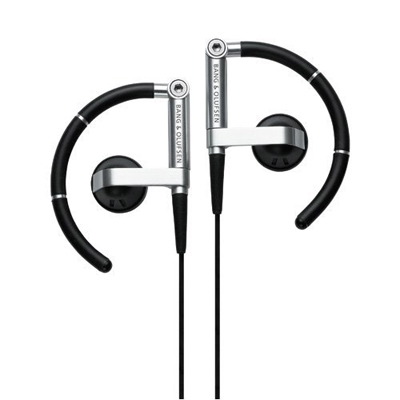
  1. Bang & Olufsen A8.  Since I had poured hundred of sheckles on the Shures, I figured ‘why stop’.  A few hundred dollars later I got the classiest earbuds I could find.  They hang on the ear so they won’t fall out every thought they are heavy.  You will not be able to wear sunglasses with these, the over-ear part is too thick.  The foam around the speaker is not meant for sweaty surfaces, but it works.  These lasted over a year.  The bad: They failed possibly due to the way I wound up the wire and put them in my pockets.  One side went out intermittently, putting the wires in a bind and they worked for another few months. 

Figure 4 B&O A8

  1. Motorola Bluetooth Headset, Wires failed me, so I tried wireless.  I recall these were on a crazy sale, so I tried them.  That was dumb.  The bad:, they are a vice pinching the softest part of your body, (the pinna).  Instant headache! And they bounce like crazy.  Buy these for people you do not like.
Figure 5 Motorola S10

  1. Yurbuds Ironman, Yurbuds expanded to making a headset.  I bought the ones called ‘Ironman’.  The box told the story of their invention, an athlete could not find a headset that worked, they all failed or bounced around, etc.  It was telling MY story.  I wept with joy and knew my search was over.  I was wrong, they suck.  The bad: The over-ear part push your ears out very far.  I looked like Liv Tyler’s idiot brother who was cut out of the LOTR movies.  There were pause/play buttons and they stopped working after ONE run, the day I bought them.  I went back to the store and exchanged them as ‘defective’.  That set last ONE RUN!  I threw them out and chalked it up as me paying my stupid-tax. 
Figure 6 Yurbuds Ironman


  1. The Bowers and Wilkins C5, this is a high quality headset.  Its method of staying in one's ear is a outward spring tension pushing into the internal curvature of the ear.  It is a good solution and can be tweaked to handle running without any bouncing.  Good sound, stays in place.  The bad: buttons failed after months of use.  Not a bad life expectancy relativelty, but costs dollars per run.
Figure 7 B&W C5

  1. The Bose SEI2I, The ‘active’ version of their headset.  I left out the Sony/Seinheiser pieces of junk, but these are shaped the same.  They are the most comfy in-ear earbuds I have ever worn.  Interestingly, they come with a short cable, but an extension, so you choose between too short or too long. (?) They take a decent beating.  The FIRST set I had survived hundreds of consecutive runs (with and without sweat)!  The bad: Finally, a earbud that will stay in my ears, seem to survive my sweat, but I washed them once and the dryer’s heat melted the wire insulation.  I haven’t wash-tested every headset I have owned, but I have washed a few and MELTING?? Come on!!>?@#wtf!>!?1!1.  Needless to say, I was so mad at Bose (whose founder died today L ), that I bought another pair.  They lasted 6.00001months and now the buttons don’t work.  My ‘alien-blood’ sweat hath done it again.  I can pause/play, but the microphone and volume up/down are inoperable.  Two pairs, about 1.5years of service.
Figure 8 Bose Sei2i

Over $1000 spent, and the search continues 


Wednesday, January 30, 2013

Are You Ready to Go Minimal?

Jay Dicharry the author of:
  

Weighs in on criteria conditions needed to try out minimal shoes using mobility test (with nice fixes to improve), muscle isolation, leg-stance balance, posture alignment.  It's a great 7mins, if you dig his stuff, buy the book for more.


Note... Even after practice, I can NOT stand on one foot with my eyes closed, I tip over as if pushed!  Let me know if you can do it!

Sunday, January 6, 2013

How to Breathe


How to Breathe?  First we talk about 'how to run' which is arguably VERY natural to humans, now how to breathe??

Consider this; a common question at the gym.  People ask 'am I just out of shape or is there a trick to breathing??'.  It is easy to dismiss such questions as 'just work harder, adapt, get fitter' but there are interesting nuances to consider.  Our bodies can recognize that we're working hard (say, during a work out) so let's increase the flow of oxygen!  A simple mechanism is to just breathe faster, but that is not always the best solution to adapt to a serious fitness demand we're placing on our bodies.  For example a measure of fitness is the VO2Max is a measure of when (given a constantly increase in effort-level) does one exhale perfectly good oxygen.  In other words, our trigger to breathe faster usurps our ability to USE the oxygen we are taking in.

Many of us are training their bodies to be fit, but there are also techniques to train our lungs to work better.   Two take ways in my research is to:

a.)breathe deeper
b.)breathe smarter

Deeper is simple to understand, when you feel like you can't get enough air, take a moment to slow your breathe's cadence and increase the depth of breathes.  Try it at as you read this, breathe deep, then try to breathe deep using your mouth.  There are benefits to using those deeper air sacs and like many skills if you consciously do it eventually you'll naturally do it!  Also play with this, experiment when in your 'zone' - how many steps (while running) do you take per breathe?  Doing burps? Give yourself the luxury of a deep breath per rep.  Make a breath what you're heading for, your milestone to reach. Say 'breath breath breath' to yourself when in a high intensity workout!

Breathing smarter is a funny way i like to say - use your breathing muscles the way they were intended.  Use your belly to breathe!  Here is a test, are you a belly or a chest breather:

You can test whether you are a chest breather or stomach breather. Place your right hand on your chest, and your left hand on your stomach and breath normally. If your right hand rise more, you are a chest breather, and if your left hand rises more, you are a stomach breather.  (By Ollie Lawson)

The stomach obviously can expand MUCH further and is therefore a better group of muscles to take in air.  I always joke with my running seminars that my race pics look ridiculous because my stomach is usually distended.  It is worth the unflattering pictures to have enough air.  

Master this, then you have no excuses ;)


Friday, July 20, 2012

Take Control of Your Cadence

You need to be the boss of YOUR cadence, don't let it be controlled by someone that's not you! I noticed sites like these (Link Here) are popping up to sell you songs in an effort to better control your running.  Their web site claims this:  


_________________________________________________________________________________
Header Technical

Linking BPM to Running Speed


How to work out which BPM to choose: The run2rhythm program is essentially coupling running cadence to music.
With running, very few people can sustain a steady rhythmic pace over an extended period. Many tend to start too fast and don’t get to finish the distance intended, or within the time targeted for the run. The run may not last as long as they intended…..”puffed out early!”


Outdoor running:

  1. Run for 15 minutes at a pace you are comfortable with
  2. If you are starting out this will be slower than if you are a conditioned runner.
  3. During that run count your steps for 1 minute. Do this several times to get an average.
  4. Then, refer to the chart below to determine the BPM you should choose.
________________________________________________________________________________


I think in their description they're smearing cadence (steps per minute) and running speed.  In a car you've got tachometer and speedometer, tach measure cadence of engine, speedo is mph of vehicle.  Like running in place is steps / min and 0 mph.  To extend my analogy too far ... a pump is an engine (like a car engine) that runs at one rpm all day.  A pump's engine's rpm was chosen to be at it's peak efficiency.  Running is much the same way.  There is little reason to deviate at ALL from YOUR personal efficient cadence when endurance running.  


What is 'my' natural cadence?  My resonance?  Well it depends, but not by much!  You can experiment by just hopping in place (two foot hops to start with) like you're jump roping. Start out springing up once a second.  You'll notice that's so slow that the spring energy you loaded on your tendons dissipates before your next hop.  Try two hops per second boing-boing-boing, you should notice that some energy is stored then released to help you spring back up.  As a boundary condition try hopping as fast as you can.  It's WORK!  A typical figure to work with is 180 steps per minute (aka 90 strides per minute).  If you want to synch that up to music or an audio metronome (many apps available for phones, or search metronome on amazon.com).  


I treat 180 spm as a MINIMUM.  If you're running there is no good reason to allow that stored elastic energy to dissipate, use it for your next stride and it doesn't hang around long!  ;).  An interesting test is to search for your maximum.  Fun thing to try at a track, do a series of 200m with rests each one increase a few strides per minute.  After 205-210 it's really hard to keep up.  What's your max?


Note: if you are synching up to music or beats, treat each beat as a foot LIFT, (not foot fall) otherwise you'll find yourself planting your foot unnaturally hard.  


Enjoy and let us know how it goes!

Friday, November 18, 2011

You're Doing It Wrong

Mr McDougall, instead of "there's only one way to run"

How about "there's only one way to find out how YOU run"

To the aggressive opponents of barefoot or barefoot-style running (can't imagine why/how you'd take that position) - picking apart the semantics is not a way to refute a good theory.  The point people like Christopher are trying to make is that the only way to find YOUR way is by including the intrinsic parts of your body, without treating bio-mechanical symptoms through over the counter footwear. 

From NY Times <Link here>
Christopher McDougall is an ardent proponent of barefoot running, but as the number of tendo-achilles and calf injuries related to running barefoot rises, it is clear to those of us who treat ailing runners that this is not the ideal form for everyone. Just as there are alternate styles of swimming or hitting a baseball, biomechanics shows us that runners should develop their own style to maximize performance.
DR. JAY KERNER,
Rockville Centre, N.Y.

There are new injuries.  People need education along with minimal footwear.  That's what places like this blog are for.  How can we better reach out to people doing TMTS (too much too soon) on muscles that have atrophied after a lifetime of over-support and cushioning??   Open to suggestions....

Monday, October 31, 2011

The Foot Drills


The Foot Drills 
By Russ Ebbets, DC 

<We did the six drills at the start of each practice. Five of the six drills are done barefooted or in stocking feet. The distance covered for each drill is about 25 meters. Each drill is done once daily. The walking is done at one’s own pace. Total time for the drill with shoes off to shoes on is about four minutes. Pretty simple. 

The six drills, illustrated above, are simply to walk on the outside of the foot (invert the foot), walk on the inside of the foot (evert the foot), walk with a toe-in, or pigeon-toed gain (adduct the foot), walk with the toes pointing out (a la Charlie Chaplin), and with the shoes back on, walk on the heels – this protects against bruising the heel. Done daily these six drills will eliminate shin splints, Achilles’ tendonitis, plantar fasciitis, lessen the chance of a severe ankle sprain and virtually all knee problems. (The famous Rice Study done in the early 90s found that 79% of running injuries are from the knee down). 

One of the reasons I had successful teams is that my athletes made it to the competition day healthy and ready to compete. Season after season was completed with virtually no injuries. It should be noted that there are three problems with the foot drills; they are simple, they are easy, and they are free. It doesn’t involve more than taking off one’s shoes and putting one foot in front of the other. But that is easier said than done. Why do the foot drills work? There is very little muscle in the foot. 
  • Most of the balance and proprioceptive sense we get comes from our muscles. 
  • The neuromuscular pathway (the communication line) from the brain to the foot is the longest and slowest in the body. This leads to bad, or at best, poor coordination of the foot. If you doubt that, put a pen between your toes and try to write your name. 
The demands of athletic participation - be it running, jumping or quick starts and stops - places tremendous stresses on the foot. In fact, the foot must sustain seven times the body’s weight with simple running, and up to 20 times body weight in some jumping activities. Done repeatedly, this is how an overuse syndrome such as shin splints, plantar fasciitis or Achilles’ tendonitis develops. By challenging the foot with various gaits, one develops a clearer pathway from the foot to the brain. Clearer pathways are faster and more responsible. This gives one better balance and proprioception. Each foot strike becomes more “sure,” the foot contacts the ground without a wobble, however slight that wobble might be. It is because of the “sure foot stride” that the overuse syndrome (Achilles’ tendonitis, plantar fasciitis or shin splints) are eliminated. It has been said that running is a ground contact sport. It is this repeated micro trauma of ground strike, repeated thousands of times than can lead to injury. Other factors, such as running surfaces and proper shoe selection, can influence the incidence of injury. But I will contend with a great deal of assurance that the six foot drills, done consistently, will have a tremendous positive benefit on one’s athletic participation and performance. Applying the simple, easy and free. The last note. The foot drills will also make you faster. I mentioned the slight “wobble” of each foot strike. More accurately described, a “wobble” is lateral, side-to-side motion. Speed is generally straight ahead. If, on each foot strike there is the wobble or lateral motion before there is the forward motion, there is lost time – not much, but some. If one’s ground contact time can be reduced 1/100th of a second (it takes 14/100ths to blink an eye,) the cumulative effect can drastically improve one’s performance. Consider this – if one takes 50 steps in the 100m, 50 x 1/100 = 50/100 seconds, or ½ a second. One-half second is the difference between the 9th place spectator and the Olympic Gold Medallist. In a mile, this reduced ground contact time translates to an 8-10 second difference and in the 10K it means between 50-60 seconds. An improvement made in the blink of an eye, one step at a time. Simple, easy and free.>