Showing posts with label endurance. Show all posts

Wednesday, August 20, 2014

How to Climb a Mountain

Maybe that should read 'why climb a mountain'.

When I did the Pikes Peak Marathon in 2013, I knew it would be ~6-7 minutes per mile slower than my road marathon pace.  This can be frustrating for a 'runner' where moving slower can seem like failure, in a way.  But if you fix effort level which can be measured by heart rate, an inclined run can turn into a walk and yield the same 160 bpm that a 7 minute/mile pace flat run can yield.

The PPM is an out and back, you get to see every runner.   It's amazing to see the range of human performance in that sample.  Some front-runners are **trucking** long strides, large broad jumps over obstacles - to - those that are doing a sort of zombie walk, leaning on rocks to catch their breath.  A  small handful of runners were heading back down the mountain having missed the cut offs at certain aid stations.

In 2013 my PPM training was convenient since I lived in Manitou Springs.  I could leave my house (on foot) and in 3 miles, I was on the Barr Trail.  For my weekly long runs, I practiced ascending to 8,000, then 9,000, etc etc until I reached the top.  I ascended the full summit 4 or 5 times before the PPM '13, taking the train back down.  I ascended by train and descended by foot a couple times.  Somehow the race went very poorly for me.  5 months of living in Colorado, the training runs, I expected to be 5:30, but it took me 6:48!  Poor estimates like this leave my wife waiting nervously at the finish line.

This year, I'd moved to Boulder training in 5,500-8,200 feet of elevation without taking a road trip.  Family/work life does lend itself to making trips to 14ers for true altitude training.  My training runs got ~20miles by late May (for the August race).  But in early June, on a business trip to Boston I tripped on a trail run and broke my toe - bad.  Cleanly, but non-displaced, fracture of intermediate metatarsal of my second toe.  This being my longest toe, any toe-off stage of gait re-stressed the fracture.  I had to be careful.  I took off the rest of June and most of July.  In my big come back I tried a 13mile sea level flat training run and I was hurting the next day(s).  Even shin splints, which I hadn't felt since my first attempts of running in 2009-10.  I was clicking off some nice 9 mile hilly runs by August.  No long runs, no altitude, but some signs of strength.

PPM 2014 arriving.  I discussed my plans for the race with my mom.  Getting someone who knows me so
Just don't trip, just don't trip
well, but doesn't understand the sport is ALWAYS helpful.  She said 'just don't trip'.  Such a simple statement and it rang in my head tap-tap-tap-just-don't trip-just-don't-trip-tap-tap-tap.  Thanks mom!  It worked, I didn't trip.  There is carnage after this race, much open wounds from many who fell!  I was not one of them.

My ascent felt great, I was walk/running watching my Heart Rate Monitor(HRM) occasionally.  NOT concerned with distance.  I tried to stay under 160, preferably 156 bpm.  I knew I could hold that for hours and hours.  In 2013 it took me just over 4hours to get up there (worse than most training runs).  PPM 2014 seemed all about restraint, I held that heart rate!  I passed person after person and ascended in 3:40.  Given my training I couldn't expect a better time, but it happened!

Is my camel-toe showing?
The turn around felt amazing, I was bounding and zig-zagging.  I thought I was making good time.  After a few miles down, I could feel the lack of volume in my training.  My muscles were tightening up even before mile 20.  Even on the less technical sections I felt like I was lucky to dip into ~10 minute/mile pace :(.  I felt the sting of people passing me.  'Just don't trip Just don't trip' kept working.  I saw people fall, people cramp up and limp off the course.  People that missed the time cut offs.  I felt ok with where I was.  I consumed ~4 scoops of Ucan Superstarch, 4 honey stinger gels, and a few handfuls of grapes (at aid stations).  For my effort level, it felt like I was perfectly sated.  Taking in 600 calories, and burning 4600 calories proves I'm pretty well fat-adapted.  A fat-burning machine?  ;).
Crossing finish line just a few minute past my goal.

Soaking my legs that would cramp  if I moved them too fast!


The final 1-1.5 miles on road surface I felt like a robot, and the finish I felt like smiling.  Temperatures reached 104 degrees in the sun on the descent.  I KNEW I'd lounge in the creek at the end.  I could feel it towards the end.


My Nathan Quickshot water bottle, Ultimate Direction AK Race vest, and Born2Run Trail Shoes worked flawlessly.

The details of my 'performance':

http://www.strava.com/activities/181738822

Tuesday, July 22, 2014

falling asleep just like running?

My latest focus in running is relaxation.  A body-audit, if you will.

Pick a body part that I shouldn't be engaging for running and ask myself if it's flexed or relaxed.  Muscles you've identified as not helping, then ask yourself if it's relaxed.  Try flexing then releasing.  Pay attention to your running form, the sound of your steps, and your breathing.

Letting go of unneeded muscles will lower your heart/breathing rate, functioning economy improvements.

I have noticed I can incorporate this technique as I fall asleep. Its good practice for muscle relaxation while running. I noticed when I lay down to sleep my hands make tight'ish fists. Recognizing this and flattening out my hands changes my breathing and increases relaxation. Flex a foot then relax it. Notices the difference?  Flex gastric chain then relax it.  Notice Tue difference. Turning off everything allows sweet sleep. Relaxing most things allows for sweet runs.


* This topic supports my theory that the key to endurance is not ability to engage muscles but is the ability to relax muscles. Extrapolated explains a cramp-inability to release a completely flexed muscle. Watching heart rate creep to maintain the same intensity is due to recruiting muscles you don't need for the motion.

Saturday, July 13, 2013

Earbuds, Not that Easy


earbuds  plural of ear·bud
Noun
A very small headphone, worn inside the ear.

As a runner I have tough requirements for earbuds. Here is a short list:

  1. stay in the ear even through running, this is where advice cannot be taken, get a set with multiple ear size fitments pieces
  2. sound isolation, a good fit in the ear will allow you to keep the volume down, your ears will relax and you will hear more of your earbuds AND outside sounds
  3. microphone, pause/play, volume up/down, the type of functions that come on earbuds included in the purchase of a smart phone.  The less you need to touch your phone while running, the longer it will last.  When I commute run I’m always talking or texting. 
  4. must survive my sweat.  This is not a feature that you can test in the store.  Simply being waterproof isn’t enough
  5. must survive the wash cycle, leaving them in your clothes should not be a death sentence

The above list seems do’able.  If we can put a man on the moon then we should be able to achieve this loftier of goals.  I have tried a few earbuds in my 4 years of running.  Here are a few memorable ones… (spoiler alert) the search continues.

  1. Iphone’s earbuds: all but iPhone Gen 2 have a wire insulation that will survive sweat.  The earlier models would not stay in my ears, but the company Yurbuds had a solution for this in Figure 2 Yurbuds.  The newer generation iPhone earbuds fit into my ear canals nicely, they survived running without falling out.  The bad: with my chemistry, the buttons and or microphone with every set of these earbuds has failed.  100%.  They will survive the winter months pretty well when there is enough clothing separating my sweat from their buttons.  Usually they fail by engaging the pause/play (which when held down wakes up Siri).  Music will pause/play on its own, calls ended, Siri asking what I want.  It is infuriating!
Figure 1 the iphone earbuds, every generation

Figure 2 Yurbuds which fit early iPhone earbuds

  1. Shure EC(all), I have tried E3c, E5c, and others.  Much improved sound quality, good seal to block out sounds and let your ears relax.  The bad: They will not stay in the ears.  The wire insulation gets hard/soft with temperature and they will fall out of your ears. I recall many not having the buttons and the wire so their functionality is sub par as well.
Figure 3 Shure

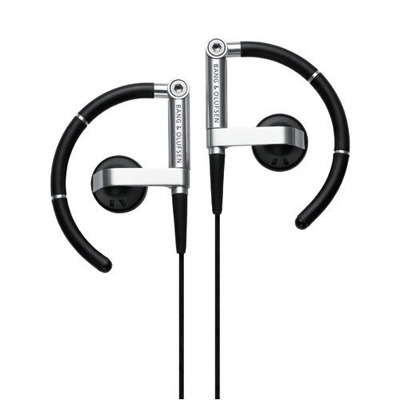
  1. Bang & Olufsen A8.  Since I had poured hundred of sheckles on the Shures, I figured ‘why stop’.  A few hundred dollars later I got the classiest earbuds I could find.  They hang on the ear so they won’t fall out every thought they are heavy.  You will not be able to wear sunglasses with these, the over-ear part is too thick.  The foam around the speaker is not meant for sweaty surfaces, but it works.  These lasted over a year.  The bad: They failed possibly due to the way I wound up the wire and put them in my pockets.  One side went out intermittently, putting the wires in a bind and they worked for another few months. 

Figure 4 B&O A8

  1. Motorola Bluetooth Headset, Wires failed me, so I tried wireless.  I recall these were on a crazy sale, so I tried them.  That was dumb.  The bad:, they are a vice pinching the softest part of your body, (the pinna).  Instant headache! And they bounce like crazy.  Buy these for people you do not like.
Figure 5 Motorola S10

  1. Yurbuds Ironman, Yurbuds expanded to making a headset.  I bought the ones called ‘Ironman’.  The box told the story of their invention, an athlete could not find a headset that worked, they all failed or bounced around, etc.  It was telling MY story.  I wept with joy and knew my search was over.  I was wrong, they suck.  The bad: The over-ear part push your ears out very far.  I looked like Liv Tyler’s idiot brother who was cut out of the LOTR movies.  There were pause/play buttons and they stopped working after ONE run, the day I bought them.  I went back to the store and exchanged them as ‘defective’.  That set last ONE RUN!  I threw them out and chalked it up as me paying my stupid-tax. 
Figure 6 Yurbuds Ironman


  1. The Bowers and Wilkins C5, this is a high quality headset.  Its method of staying in one's ear is a outward spring tension pushing into the internal curvature of the ear.  It is a good solution and can be tweaked to handle running without any bouncing.  Good sound, stays in place.  The bad: buttons failed after months of use.  Not a bad life expectancy relativelty, but costs dollars per run.
Figure 7 B&W C5

  1. The Bose SEI2I, The ‘active’ version of their headset.  I left out the Sony/Seinheiser pieces of junk, but these are shaped the same.  They are the most comfy in-ear earbuds I have ever worn.  Interestingly, they come with a short cable, but an extension, so you choose between too short or too long. (?) They take a decent beating.  The FIRST set I had survived hundreds of consecutive runs (with and without sweat)!  The bad: Finally, a earbud that will stay in my ears, seem to survive my sweat, but I washed them once and the dryer’s heat melted the wire insulation.  I haven’t wash-tested every headset I have owned, but I have washed a few and MELTING?? Come on!!>?@#wtf!>!?1!1.  Needless to say, I was so mad at Bose (whose founder died today L ), that I bought another pair.  They lasted 6.00001months and now the buttons don’t work.  My ‘alien-blood’ sweat hath done it again.  I can pause/play, but the microphone and volume up/down are inoperable.  Two pairs, about 1.5years of service.
Figure 8 Bose Sei2i

Over $1000 spent, and the search continues 


Wednesday, May 29, 2013

Low Calorie High Energy, and Other Oxymorons

As an paleorunner and amateur biohacker I notice things.  Recent example, energy is defined by Websters as:

Definition of ENERGY

1
a : dynamic quality <narrative energy>
b : the capacity of acting or being active <intellectualenergy>
c : a usually positive spiritual force <the energy flowing through all people>
2
: vigorous exertion of power : effort <investing time andenergy>
3
: a fundamental entity of nature that is transferred between parts of a system in the production of physical change within the system and usually regarded as the capacity for doing work
4
: usable power (as heat or electricity); also : the resources for producing such power

Most importantly, energy is quantitative, it's measurable.  When it is measured the units are Joules, calories, BTUs, etc depending on the application (like distance is measured in inches, miles, mm, parsecs, depending on the application).  

So the question is how can something be low calorie (the unit of measure of energy) and high energy at the same time?  It is an easy answer, it can't.  Food energy is heat given off through the digestion/respiration of food.  Food is referred to as food energy.  We eat for energy, flavor and fun ;).  

Fats and ethanol have the greatest amount of food energy per mass, 9 and 7 calories/gram, respectively. Proteins and most carbohydrates have about 4 calories/gram (I am using dietary calories here, which are a kilocal). Carbohydrates that are not easily absorbed, such as fiber or lactose in lactose-intolerant individuals, contribute less food energy. Polyols (including sugar alcohols) and organic acids have less than 4 calories/gram.

So you have to eat 2 grams of sugar to get the same amount of energy as 1 gram of fats.  In (overly) simple terms, you need to eat 2 lbs of sugary foods just to make it through the day, but you'd only need to eat 1 lb of fats for the same energy output.  High fat diet means less food.  

Life advice: You need to solve the macronutrient (aka, carbs, proteins, fats) needs before you ever consider micronutrients (vitamins and minerals).

For more on the differences in calories, read: