Showing posts with label minimalistic shoe. Show all posts

Monday, March 24, 2014

High Protein as bad as Cigarettes?

Seen this headline? "Meat, dairy may be as detrimental to your health as smoking cigarettes, study says"
This latest news story on diet and health is the confirmation bias people that are against what our ancestors ate.  One issue I have is the definition of high protein.  I don't know a paleo eater that is in it for the protein.  It's the energy density of the fats that sets ancestral diets from the current un-time-tested dietary fads of today.

The news story from Here reads:

<<
Eating a diet heavy on meat and cheese may be as harmful to you as smoking a cigarette, researchers claim.
A new study, published in Cell Metabolism on March 4, shows that middle-aged people who eat a diet high in animal proteins from milk, meat and cheese are more likely to die of cancer than someone who eats a low-protein diet. The research also showed the people who ate lots of meat and dairy were more likely to die at an earlier age.
"There's a misconception that because we all eat, understanding nutrition is simple. But the question is not whether a certain diet allows you to do well for three days, but can it help you survive to be 100?" study co-author Valter Longo, Edna M. Jones professor of biogerontology at the USC Davis School of Gerontology and director of the USC Longevity Institute in Los Angeles, said in a press release.

Longo had previously done research on a protein that controls a growth hormone called IGF-I, which aids in body growth. Very high levels of IGF-I have been associated with an increased cancer risk. ...
>>> and so on.  The study they cite clearly uses relative percentages, that is to say if a group has one mortality in one group and two mortalities in another group, it's a 100% increase??!!  Makes for great headlines.   Better explained here: 
<For instance, this study found that among the NHANES III participants who were diabetes-free at the study’s onset, those eating the most protein were 73 times more likely to die of diabetes (yikes!). But if we look at the absolute numbers, which are tucked away in a little PDF supplement accompanying the study, we’d see that 0.2 percent of the low-protein group died of diabetes (one person) versus 2.0 percent of the high-protein group. That’s an absolute difference of 1.8 percent, which no longer sounds quite as horrifying.>  
A review of the story by Denise Minger, (author of Death by Food Pyramid) write the following from Here.  Check her stuff out!

Tuesday, February 18, 2014

Snow and Ice Running Solutions

Been playing with screws in shoes, Kahtoola Microspikes and Yaktrax Runs.  My trails look like this (click here).

Summary: they each have their place.


1. The YakTrax Runs are very lightweight (lighter than the Kahtoola Microspikes) and easy to put on.  The strap that goes over the forefoot makes them very secure.  The first warning I got about Yaktrax was they may come off the forefoot, but this velcro strap fixes that.  (using them click here)
There are six carbide steel dull spikes in the forefoot area.  Three in each of two flat pads.  The directions tell you NOT to run on roads or rocks because you will tear these spikes out.  I have about 150 miles on mine and my spikes are bent, some are pushed flush in to the hard plastic.  I did not exactly follow the directions.  In my trails, when there's snow and ice there's STILL exposed rocks.  I think it'd need to snow many feet deep to cover the rocks in my area.  I thought they would be good in mud, but this pic will show the potential issues with that: 

The mud is caked and hides the spikes immediately.  The hard plastic pads have one more issue in my experience.  Just enough snow will get caught in those pads and freeze.  I notice this right away as it feels like there's an acorn in my shoe.  The frozen acorn-sized chunks of snow caught between the pads and my sole freeze and press in to the soft midfoot area.  I have to stop running regularly to clean out this compressed snow.  This is very difficult since my fingers are typically worthless at this point.  The springs along the middle and heel of the foot work GREAT and give me the traction I need.  I score these thusly:
  • six out of ten for effectiveness 
  • three out of ten for longevity
  • eight out of ten for ease of use
2.  Kahtoola MicroSpikes are sadly about as heavy as the thin minimalist shoes I wear.  I notice that I have them on and I am sure they weigh me down!  But the traction and ability to stay on and not need adjustment are unimproveable.  Again, only because I wear such thin shoes, the elastic on these is so strong it bends my toes up and my big toe can feel bruised after a few hours of wear.  I would not use these for an ultra race.  If your shoes are as thin as mine, be prepared to feel the spikes pushing back up into your feet.  This can take some getting used to if your feet are normally pampered.  

Stock photo:
These are a must have for frequent snow/ice runs.
  • eight out of ten for effectiveness 
  • eight out of ten for longevity
  • four out of ten for ease of use (dinged for being heavy and elastic hurting my little feetz)
3. Screw in the shoes - is a way to turn a pair of trail shoes in to a snow/ice biting tool.  Because the screws are in the sole, they won't come out easily so this solution is most likely to see pavement or concrete en route to your trail run.  I used my B2R Trail shoes for this since the stack height is sufficient for me running 3/8" teck screws in to the foot.  

The screw heads provide the bite into the ice and snow.  Not nearly as helpful in snow as the microspikes.  But their longevity and serviceability after hitting road surfaces and rocks is attractive to the do-it-yer'selfer.  The amount of added weight is negligible and the difference in feeling for my foot is slight.  Sometimes I swear I can feel the sharp point of a screw when I hit a rock 'just righ' (wrong).  But no foot damage or discomfort.  I could double the # of screws in the foot bed for more traction on ice, but I feel it'd get too slippery on harder surfaces.  
  • four out of ten for effectiveness 
  • five out of ten for longevity
  • nine out of ten for ease of use

Saturday, July 13, 2013

Earbuds, Not that Easy


earbuds  plural of ear·bud
Noun
A very small headphone, worn inside the ear.

As a runner I have tough requirements for earbuds. Here is a short list:

  1. stay in the ear even through running, this is where advice cannot be taken, get a set with multiple ear size fitments pieces
  2. sound isolation, a good fit in the ear will allow you to keep the volume down, your ears will relax and you will hear more of your earbuds AND outside sounds
  3. microphone, pause/play, volume up/down, the type of functions that come on earbuds included in the purchase of a smart phone.  The less you need to touch your phone while running, the longer it will last.  When I commute run I’m always talking or texting. 
  4. must survive my sweat.  This is not a feature that you can test in the store.  Simply being waterproof isn’t enough
  5. must survive the wash cycle, leaving them in your clothes should not be a death sentence

The above list seems do’able.  If we can put a man on the moon then we should be able to achieve this loftier of goals.  I have tried a few earbuds in my 4 years of running.  Here are a few memorable ones… (spoiler alert) the search continues.

  1. Iphone’s earbuds: all but iPhone Gen 2 have a wire insulation that will survive sweat.  The earlier models would not stay in my ears, but the company Yurbuds had a solution for this in Figure 2 Yurbuds.  The newer generation iPhone earbuds fit into my ear canals nicely, they survived running without falling out.  The bad: with my chemistry, the buttons and or microphone with every set of these earbuds has failed.  100%.  They will survive the winter months pretty well when there is enough clothing separating my sweat from their buttons.  Usually they fail by engaging the pause/play (which when held down wakes up Siri).  Music will pause/play on its own, calls ended, Siri asking what I want.  It is infuriating!
Figure 1 the iphone earbuds, every generation

Figure 2 Yurbuds which fit early iPhone earbuds

  1. Shure EC(all), I have tried E3c, E5c, and others.  Much improved sound quality, good seal to block out sounds and let your ears relax.  The bad: They will not stay in the ears.  The wire insulation gets hard/soft with temperature and they will fall out of your ears. I recall many not having the buttons and the wire so their functionality is sub par as well.
Figure 3 Shure

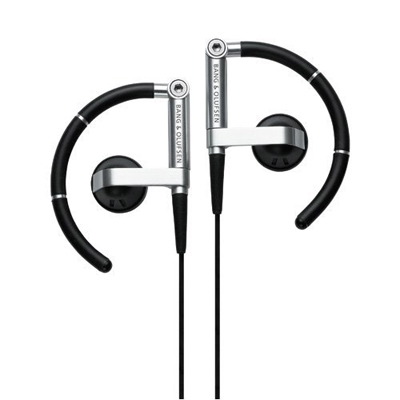
  1. Bang & Olufsen A8.  Since I had poured hundred of sheckles on the Shures, I figured ‘why stop’.  A few hundred dollars later I got the classiest earbuds I could find.  They hang on the ear so they won’t fall out every thought they are heavy.  You will not be able to wear sunglasses with these, the over-ear part is too thick.  The foam around the speaker is not meant for sweaty surfaces, but it works.  These lasted over a year.  The bad: They failed possibly due to the way I wound up the wire and put them in my pockets.  One side went out intermittently, putting the wires in a bind and they worked for another few months. 

Figure 4 B&O A8

  1. Motorola Bluetooth Headset, Wires failed me, so I tried wireless.  I recall these were on a crazy sale, so I tried them.  That was dumb.  The bad:, they are a vice pinching the softest part of your body, (the pinna).  Instant headache! And they bounce like crazy.  Buy these for people you do not like.
Figure 5 Motorola S10

  1. Yurbuds Ironman, Yurbuds expanded to making a headset.  I bought the ones called ‘Ironman’.  The box told the story of their invention, an athlete could not find a headset that worked, they all failed or bounced around, etc.  It was telling MY story.  I wept with joy and knew my search was over.  I was wrong, they suck.  The bad: The over-ear part push your ears out very far.  I looked like Liv Tyler’s idiot brother who was cut out of the LOTR movies.  There were pause/play buttons and they stopped working after ONE run, the day I bought them.  I went back to the store and exchanged them as ‘defective’.  That set last ONE RUN!  I threw them out and chalked it up as me paying my stupid-tax. 
Figure 6 Yurbuds Ironman


  1. The Bowers and Wilkins C5, this is a high quality headset.  Its method of staying in one's ear is a outward spring tension pushing into the internal curvature of the ear.  It is a good solution and can be tweaked to handle running without any bouncing.  Good sound, stays in place.  The bad: buttons failed after months of use.  Not a bad life expectancy relativelty, but costs dollars per run.
Figure 7 B&W C5

  1. The Bose SEI2I, The ‘active’ version of their headset.  I left out the Sony/Seinheiser pieces of junk, but these are shaped the same.  They are the most comfy in-ear earbuds I have ever worn.  Interestingly, they come with a short cable, but an extension, so you choose between too short or too long. (?) They take a decent beating.  The FIRST set I had survived hundreds of consecutive runs (with and without sweat)!  The bad: Finally, a earbud that will stay in my ears, seem to survive my sweat, but I washed them once and the dryer’s heat melted the wire insulation.  I haven’t wash-tested every headset I have owned, but I have washed a few and MELTING?? Come on!!>?@#wtf!>!?1!1.  Needless to say, I was so mad at Bose (whose founder died today L ), that I bought another pair.  They lasted 6.00001months and now the buttons don’t work.  My ‘alien-blood’ sweat hath done it again.  I can pause/play, but the microphone and volume up/down are inoperable.  Two pairs, about 1.5years of service.
Figure 8 Bose Sei2i

Over $1000 spent, and the search continues 


Thursday, April 18, 2013

High-Altitude Training: Fact vs. Fiction

Before we get to the article, about 3months ago I moved to >6,000ft of elevation from sea level.  I wanted to think that I would work hard to acclimate to

1. The change in air pressure (it's not a difference in O2 content, as is commonly thought).

2. The hILLs ;).  A simple road commute to work is a ~10miles run with almost a 1/2 mile of cumulative UP.  This is with start and stop points differing by a few hundred feet of elevation, so the rolling hills are what's doing it.  It's not just rolling, i can leave my house and run ~15miles and be at the top of pikes peak with a cumulative climb of 10,000'!

3. The god-send, aridness!  Being from the midatlantic, the concept of convective cooling is not in our vocabulary.  In order for sweat to cool you evapoartively, the atmosphere has to be able to be capable of taking on more water.  This is usually directly linked to the dew point.  Running in humidity is like growing a new limb.  A cool day you send vast amounts of blood to your working muscles.  In heat+humidity it's your skin that gets priority.  The biggest organ in my body (sorry Mrs Paleorunner, I mean my skin) needs the most blood first!

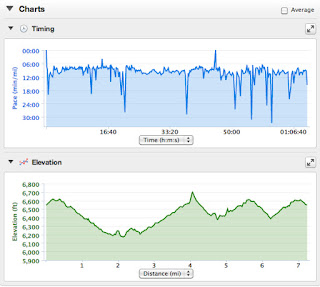
During this 3month process, there's been moving and a new job cutting into my training a bit.  But I finally had a chance to compare my fitness a little (albeit unscientifically).  I was in Florida for business and I thought, aha - more air pressure, NO hills I should blaze through a run.  Then, the heat+humidity had a different plan for me :).  But I was able to maintain a zone 2,3 run at my 6month ago marathon pace for ~7miles.  Good sign as it was relatively easy.  Then after 5 days in FL, back to colorado on the relatively flat trails behind my house.  Let's compare my performance. (same runner, same shoes, days apart, same relative perceived effort (RPE))

Colorado:
Distance: 7.45 miles
Pace: 9:41 / mile
Cumulative Elevation Ascent:  1600 feet
Temp/Humidity: 79 F / 23 %


Florida:
Distance: 8.61 miles
Pace: 7:19 / mile
Cumulative Elevation Ascent:  25 feet
Temp/Humidity: 82 F / 80 %


Heat is a big factor, but running uphill is bigger!  

Now on to the fact/fiction from Active.com:

Outdoors
Many athletes use altitude-training programs to enhance their physical performance. However, utilizing these concepts for fitness purposes can be a little tricky. Here are some of the common thoughts, right or wrong, regarding high-altitude training and how it can help or hurt you in your fitness pursuits.

Training at altitude is beneficial because the air is thinner.

FICTION
It’s not the lack of oxygen that makes your body work so hard at altitude. It really has to do with the barometric pressure. Even at 10,000 feet, there is still 29 percent oxygen in the air, and out of that 29 percent you only take in around 10 percent of the oxygen you breathe. The big challenge is your ability at altitude to extract the oxygen and get it into your bloodstream at altitude.

More
: The Effects of High-Altitude Training
At sea level, your body uses air pressure to its advantage. It allows all of the weight from the atmosphere to help push the air into your lungs, moving the air from an area of greater pressure to lower pressure.
The same happens at a cellular level, where the pressure then allows the air (including oxygen) to be pressed into your bloodstream.
When you work at a place that is higher than sea level, you start to experience less barometric pressure. Thus the air is not forced into the bloodstream as easily, making the body work harder.
Over time, the body will grow more red blood cells to help ease the struggle of getting oxygen. These cells help carry oxygen through the body, which will result in better fitness/sports performance.

Training at altitude will make me more fit.

FACT
Professional and Olympic athletes have known the benefits of altitude training for years. After all, there is an Olympic Training Center in Colorado Springs, Colorado, for a very good reason. If someone trains at altitude, they will see improvements in their maximal oxygen uptake (the ability to take oxygen in and move it into the blood stream), increased lactate threshold (the ability of the body to get over the “burn”), improved power output, and better sleep (which helps repair the body). These benefits are all a result of the red blood cell production caused by the adaptation to low-barometric pressure.

If I train with a mask that restricts airflow, it will simulate training at altitude.

FICTION
As stated before, the benefits of altitude training are not found from areas that lack oxygen, but from areas of lower-barometric pressure. Restricting airflow does not simulate training in altitude. In fact, training with reduced oxygen can cause serious problems like hyperventilation, disorientation, rapid heartbeat, elevated blood pressure and loss of consciousness.
Better use of altitude training would be sleeping in a hyperbaric tent. These tents create an enclosed, simulated altitude that allows the body to see results of altitude training while residing at sea level. These tents can be purchased or rented and assembled in your own bed. Some places offer hyperbaric chambers that you can visit for a fee. The “altitude” is adjusted slowly as the body adapts, and it has been proven to yield positive results.
Though air-restrictive masks may prove beneficial for some athletes whose sport requires working with low-oxygen levels, the masks pose danger to those using them to "get fit.”

If I train at altitude, then race at sea level, I’ll see better performance.

FACT
Well, this is a tricky one. Depending on the environment, it could backfire on you. If you spend time training in Colorado, which is high and very dry, then do a marathon in Florida, which is low and very wet; you may experience some problems because of the humidity. However, generally, you should see better times, strength and recovery if you train at altitude (or simulated altitude), and then perform at sea level.

If I train at sea level and plan to do a race in the mountains, then it’s probably a good idea to get there a few days early to prepare for the race.

FICTION
When you’re not accustomed to altitude, you have two choices: do the race immediately—within a day—or wait 7 to 10 days before racing. If you get to an event a couple of days before, your body has time to figure out that you are in a different environment, and then it will start making the necessary changes it needs to survive at altitude. Your body will become stressed, and then it will show in your performance.
If you do the event immediately, it will not have time to start adapting, and you should not see terrible challenges to your pulmonary system. If you get there 10 days ahead of time, your body will have plenty of time to fully acclimate.

Wednesday, January 30, 2013

Are You Ready to Go Minimal?

Jay Dicharry the author of:
  

Weighs in on criteria conditions needed to try out minimal shoes using mobility test (with nice fixes to improve), muscle isolation, leg-stance balance, posture alignment.  It's a great 7mins, if you dig his stuff, buy the book for more.


Note... Even after practice, I can NOT stand on one foot with my eyes closed, I tip over as if pushed!  Let me know if you can do it!

Saturday, January 5, 2013

Overuse Injuries


Oh how i enjoy taking two sides of an issue to see which explanation is the more supportable (it's a science thing).  Sometimes the counterintuitive explanation is the correct one.  Knowing this, and knowing 'words have meaning' - we enjoy picking apart words, diagnoses, explanations, etc…

We can't help but chuckle when hear the term "overuse injury" used to 'describe' running injuries.  In googling it (in quotes) gives you about 83,500 results.  The top 3 are definitions.  

sportsmedicine.about.com  Definition: Chronic pain and injury refers to the sort of physical injury, ... are sometimes referred to as cumulative trauma or overuse injuries. 
emedicine.medscape.com  Overuse injuries, otherwise known as cumulative trauma disorders, are described as tissue damage that results from repetitive demand over the course of time. The term refers to a vast array of diagnoses, including occupational, recreational, and habitual activities. 
http://medical-dictionary.thefreedictionary.com/ Overuse injury
Sports medicine A sports- or occupation-related injury that involve repetitive submaximal loading of a particular musculoskeletal unit, resulting in changes due to fatigue of tendons or inflammation of surrounding tissues; OIs include tennis elbow and golf elbow. 

From emedicine: "cumulative trauma" sounds more like blows from a hammer than feet landing on the ground doing something as natural as running.  We assumed these definitions might be silly because it is so common to describe running as feet slamming on the ground, or pounding the pavement.  But obviously, some of us realize running has been with humans for millions of years - an adaptation used to survive.  Running is as natural to humans as breathing, or the muscles used to balance or stand; or having a beating heart.  These are muscle contraction too and not likely to hurt or be sore due to 'overuse'.

If you've been running non-stop since childhood with a form that is natural to the variable compliances of the muscles and tendons at your natural cadence with appropriate protection yet proprioception- we DOUBT seriously that you'll have an injury from overuse!!  It's more aptly an issue of underuse.

An explanation or diagnosis of an injury, condition, whatever must have the distinction between proximal cause, ultimate cause, fundamental cause.  There are chains of causes some proximal, some ultimate.  Some medical professionals have fancy terms for things that nothing more than a regurgitation of the symptoms.  " i have pain in my foot arch"  "oh you have plantar fasciitis"   which is what you said to them!  

Example: 
I am hurt due to an inflammation of a tendon, that's proximate.  The tendon is inflamed because of a muscle imbalance, that's an ultimate cause.  There is a muscle imbalance because of a form issue, biomechanics, leg length discrepancy, neuromuscular disconnect, or simply NO feedback mechanism of your bad form due to your overly cushioned shoes.  
Think about it, and don't settle for lame diagnoses.  

Sunday, November 25, 2012

Footwear Trends: Should Sport & Fitness Enthusiasts Embrace the Minimalist Movement?


Link Here:


Footwear Trends: Should Sport & Fitness Enthusiasts Embrace the Minimalist Movement?

ISSN: 1543-9518


ABSTRACT

The popularity of the barefoot movement in sports and fitness activities has soared within the past few years as evidenced by a growing community of minimalist
footwear enthusiasts wearing the ‘glove’ shoes in their sporting endeavors, fitness workouts, and everyday leisure activities. This emergence
of the minimalist shoes, such as the Nike Free© and Vibram FiveFingers®, has created a wave of intrigue for those sport and fitness enthusiasts wanting
a natural running experience without being subjected to the hazards of the road. Whether running barefoot, in shoes or in minimal footwear, the trends in footwear
preference have caused much debate between researchers as to which form causes more injuries and/or best serves to enhance athletic performance. As sport and
fitness professionals, it is important to thoroughly examine the current footwear trends to develop a ‘best practices’ approach for advising our athletes
and clients.
Click above link for entire article.  It is a great summary of minimalist footwear.

Wednesday, September 12, 2012

Ticking Time Bomb, How Children's Shoes Cause Problem Later in Life


15
MAY/11
Off

Ticking Time Bomb, How Children's Shoes Cause Problem Later in Life
What's wrong with this photo? Plenty! The young boy's shoes will screw up his gait and cause muscle imbalance. And he's stretching!
by Dr. Phil Maffetone
Twenty years ago, a review of shoes and gait in the journal Pediatrics outlined some key factors that affect children’s feet. Pediatric orthopedist Lynn Staheli, M.D., from the Children's Hospital and Medical Center, Seattle, Washington, listed these important points:
1.) Optimum foot development occurs in the barefoot environment.
2.) Stiff and compressive footwear may cause deformity, weakness, and loss of mobility.
3.) The term "corrective shoes" is a misnomer.
4.) Shoe selection for children should be based on the barefoot model.
5.) Physicians should avoid and discourage the commercialization and "media" obsession with faddish footwear.
6.) Merchandising of the "corrective shoe" is harmful to the child, expensive for the family, and a discredit to the medical profession.

The Nike V Infant toddler shoe.
Perhaps the most offensive aspect of the footwear industry is the harm it deliberately inflicts upon unsuspecting children by encouraging them to wear bad shoes. Between the twin forces of television and parental encouragement, little Johnny or Jill are defenseless. In particular, there's the potential damage to the young developing body and brain. And, this could be a primary cause of physical imbalances, injury and disability and later as adults.
It was evident from Dr. Staheli’s article that shoe companies in 1991 were already heavily marketing unhealthy children’s shoes, playing on the parent’s emotions and those of older children. Today, shoe companies continue to use clever million-dollar advertising campaigns to encourage kids to ask for, and parents to buy, harmful shoes. And it’s obviously successful. The U.S. children’s footwear industry, which includes shoes for kids up to 16 years of age, generates over $5 billion annually, where products are made for cuteness and style rather than function.
What’s the best shoe for your child? None—barefoot is best and nothing comes close. Children should be barefoot, most, if not all the time. This provides the optimal stimulation of the foot by the ground, which helps train the brain for proper gait and other natural movements that children require from the start.
When a shoe becomes absolutely necessary, Dr. Staheli says it should be lightweight, flexible, shaped more or less quadrangularly, and should not have arch supports and stiff sides. She says that pediatric orthopedists strongly oppose "corrective" or "orthopedic" shoes for straightening foot and leg deformities like flat feet, pigeon toes, knock-knees, or bowlegs, claiming there’s no evidence that these so-called therapeutic shoes are effective. Instead most of the supposed deformities in children naturally correct themselves. How you might ask?
Being barefoot is the best way for that to happen. Most healthcare professionals who properly understand a child’s body mechanics know this. (Yet there are many “experts” who recommend the regular use of shoes for young children, but they are usually aligned with the shoe industry or companies making orthotics and other corrective devices.)
Any shoe has the potential to seriously disturb the gait of a young child. His or her sensitive feet sense footwear much more than the adult foot. Even relatively minor pressure on a child’s foot from a shoe can begin deforming it, leading to a permanent problem.

During the first year following the acquisition of independent walking, most of the child’s gait activity, in particular, the neurological memories—the communication between brain and body—becomes well established.

Barefoot is best for children.
During this time, if the feet are not allowed to develop well, gait and balance disorders begin to occur. In many children, these irregularities are often subtle (the “clumsy kid”) while others more serious such as increased vulnerability to physical injury and various neurological imbalances anywhere in the body, including those associated with eye movement.
The full development of a child’s balance and compensatory mechanisms, and overall gait mechanics, takes years to mature. While the first five years of life are most delicate, neuromuscular interference from footwear can occur at any and every stage along the way into early adulthood. This can lead to more serious and chronic physical imbalances later in life, such as a running injury or back pain, and even amplify the stress caused by imperfect shoes.
Earlier this year, Caleb Wegener, Ph.D., and colleagues from the University of Sydney, Australia, reviewed the problems associated with a variety of different shoes worn by children for walking and running. Their study, published in the Journal of Foot and Ankle Research, states that, “Shoes affect the gait of children. With shoes, children walk faster by taking longer steps with greater ankle and knee motion and increased tibialis anterior activity. Shoes reduce foot motion and increase the support phases of the gait cycle. During running, shoes reduce swing phase leg speed, attenuate some shock and encourage a rearfoot strike pattern.” In short, these are some of the specific items that are a recipe for physical and neurological disaster, and the start of a process of chronic injury and disability that could last a lifetime.
These researchers noted Dr. Staheli’s 20-year old suggestion that shoe design should be based on the barefoot model. But some of the shoes they tested were designed on these principles and still caused gait irregularities in children. 

The researchers also state that, “Further attention could also be paid to reducing the weight of shoes which may be responsible for some of the [abnormal] changes found in children’s walking and running gait.” (It’s interested that this type of “free” information is available to shoe manufacturers but may never be utilized—instead, they test their shoes on machines, not real people.)
Among the untold problems that wearing shoes can impose in the developing child is the impact on the brain. From a baby’s very first delicate steps, each walking and running gait pattern significantly influences brain development. These actions affect lifelong patterns in the nervous system, even beyond the gait and balance mechanisms—they include postural habits, the ability to compensate to physical stresses, and the growth of muscles, bones, ligaments, tendons and other tissues. Normally, with each muscle contraction and relaxation, and every joint movement, important neurological patterns are created by the brain, just like with any memory. Shoes distort this process, and instead, the brain learns and designs irregular patterns of movement throughout the body.

Most childen's shoes are health hazards. It's like handing them "smokes"-- which is what candy companies did for many years.
In addition, other areas of the brain can be impaired. Normally, during early development in children, all the important neurological input from body movements trigger increased blood flow throughout the brain. This brings in oxygen and many other necessary nutrients to promote growth and development in areas that include learning, speech, and memory. Without the natural muscle contraction in the feet, for example, especially in the very small immature muscles that move the toes, impairment from wearing thick, oversupported modern shoes can reduce the brain maturing process.
In children plagued with posture- and gait-related problems, avoiding wearing shoes is even more important. This can help stimulate the above-mentioned neurological functions, which can, in itself, be very therapeutic. Rather than attempting the use of “corrective” shoes and related devices, such as inserts or braces, finding and correcting the causes, including  neuromuscular imbalance, is important.

Many physical ailments in adults could begin at this young age. Think about all the physical problems you’ve had in your life—it’s possible that many began during development of the important brain-body mechanisms due to significant interference by shoes.
It seems silly to even be discussing the issue of children’s shoes. Most people don’t question the fact that eating junk food is bad for kids, or smoking cigarettes. The level of brain and body stress from wearing bad shoes can be just as damaging. The most logical, effective, and healthiest way for children to develop their whole body is by being barefoot.
This essay originally appeared on Dr. Phil Maffetone's website. For more information on the do's and don'ts of children's shoes, Dr. Mark Cucuzzella has a lot more on the kids page on hisTwo Rivers Tread website. 

Friday, November 18, 2011

You're Doing It Wrong

Mr McDougall, instead of "there's only one way to run"

How about "there's only one way to find out how YOU run"

To the aggressive opponents of barefoot or barefoot-style running (can't imagine why/how you'd take that position) - picking apart the semantics is not a way to refute a good theory.  The point people like Christopher are trying to make is that the only way to find YOUR way is by including the intrinsic parts of your body, without treating bio-mechanical symptoms through over the counter footwear. 

From NY Times <Link here>
Christopher McDougall is an ardent proponent of barefoot running, but as the number of tendo-achilles and calf injuries related to running barefoot rises, it is clear to those of us who treat ailing runners that this is not the ideal form for everyone. Just as there are alternate styles of swimming or hitting a baseball, biomechanics shows us that runners should develop their own style to maximize performance.
DR. JAY KERNER,
Rockville Centre, N.Y.

There are new injuries.  People need education along with minimal footwear.  That's what places like this blog are for.  How can we better reach out to people doing TMTS (too much too soon) on muscles that have atrophied after a lifetime of over-support and cushioning??   Open to suggestions....

Monday, October 24, 2011

Absorption - Why is Energy Return a Bad Thing?

If all is sequenced well, and if proper form is used, running is partially muscle (work) and elasticity (energy return). Both of which your natural human form is more than capable of; in fact, your body is built for these functions. Contrary to popular shoe-salespeoples' (and some doctors') beliefs, cushioning in your running shoe alters your running stride in a negative way: by limiting the natural elasticity in your running stride. Let's look at the mechanics.

When we land on the ground during our foot strike our muscles tighten and springy tendons lengthen.  Our weight is absorbed by springs in the feet and legs. If we hold that muscular tension until it's time to lift that foot back up, we get to take advantage of the spring tension of those tendons.  The stored energy in those springs act like a helping hand - a little springy assist to get us into our next stride.  
Seems like a system designed pretty well. So how do we mess it up? Think about it this way: If you sprung that spring tension prematurely then you'd have to use ALL muscle to get you into your next stride.  That's how we mess it up: by springing the tension early with well-cushioned footwear.  Cushioning absorbs the stored spring energy and you don't get the assist you would normally. 
Here's a visual that reinforces the point: Imagine you're bouncing a basket ball.  The stored elastic energy gets the ball 80% of the way up to your hand.  The other 20% comes from you using downward muscular force.  Think about how hard you have to push that basketball so it will return to your hand, dribbling down the court.  Now think about how hard you'd have to bounce the ball if it were on a softer surface, like a gymnastics mat.  A thick mat, like a gymnastics mat, functions as a cushion that will absorb a great deal of that stored spring energy. The stored energy is not returned to the ball.  To get the ball back up to your hand you have to push hard enough to make up for the loss in the ball AND the mat.  The springiness of the gymnastics mat (or any other cushioning-type surface) is horrible for energy return.
No surface is as good as the hard floor in returning the stored elastic energy in the ball. 
Similarly, no spring constant (in the form of cushioning) in a shoe will help the runner get that energy back.  The runner's muscles have to make up that work. 
Save your energy for running, not cushioning and see your speed and efficiency improve and your injury rate decrease (provided you use natural form).

Tip:
Note we have to "hold that muscular tension" - seems like a lot of work, right?  To reduce how long muscles are engaged while you run: speed up your cadence! Remember: Shock absorbed by springiness in your body is returned again in your next stride.