Showing posts with label minimalist shoe. Show all posts

Wednesday, November 26, 2014

Qualitative thoughts about running form

Built to Run: If you have been convinced by the science that upright-walking humans are formed over time to be the ultimate long distance running machines in dry hot weather.  If you have not heard this hypothesis and its supporting evidence, please click here.


Running Form: With a rudimentary understanding of human anatomy we can make some assumptions about the running form most conducive to our structure.  Some of the action verbs required to run:
  • Twist - the trunk 
  • Swing - legs/arms
  • Reach - reach in front and bhind
  • Absorb - landing, absorbing the momentum down loads the springs of the body 
  • Propel/Push-Off - propel over the landed foot, and extend legs, toe off.
Big to Small: Always tackle a problem big-to-small.  Working on the assumption that the biggest muscles need to bear the biggest loads.
  1. The glutes:
"The gluteus maximus is the largest muscle in the human body. It is large and powerful because it has the job of keeping the trunk of the body in an erect posture. It is the chief antigravity muscle that aids in walking up stairs."
The glutes do two things: keeps you from folding in half like a pocket knife and pushes your thigh from a raised position to a lowered position (sitting to standing).  If you have good upright, "hips-open" posture when running, you can dedicate this muscle group to absorbing and propelling the leg down and back.  If your posture is bad, you engage the glute to keep you from folding in half.  The glutes need to share their capacity to maintain your bad posture AND run.  The strongest movement of the glutes is pushing back - this is what propels you forward.  Try to fire this muscle when it contributes most.  The glutes are ~25% of your running muscles, make them do 25% of the work.  (25% pulled from the sky.)

   2.  The quads:

The next biggest cluster of muscles and cetrtainly the longest.  The Quads is an eccentric powerhouse, it absorbs your landing, turning all that downward momentum into stored energy.  The quads stops you from collapsing and in contraction straightens your leg.  It is the heel-cushioned running shoes that incorrectly allows you to straighten your leg WAY too soon.  Landing with knees slightly bent stored the most energy, straightening the leg should happen at push-off, firing simultaneously with the glutes.  It's the one-two punch of propulsion.  The quads are ~20% of your running muscles, make them do 20% of the work.  (20% pulled from the sky.)

  3. The trunk:

Twisting the trunk is often over looked.  We coach pitchers, batters, boxers, golfers, etc to originate motions in the hugely muscled trunk.  A perfect punch begins at the foot, twists the hips, twists the trunk extends the arm.  The arm is a messenger of the forces generated from the 'big boys' of the muscle groups.  Running is the inverse of that.  A trunk twist turns into a foot motion.  Twisting the trunk allows the reach portion of the running stride and extends the push off out the back.  The more the twist, the longer the stride (at the same cadence).  I think of the 'X' created by the shoulders and hips when I'm driving my knee forward and pushing out the back.  Arm swing exists only to engage this twisty spring mechanism.  The trunk is ~15% of your running muscles, make them do 15% of the work.  (15% pulled from the sky.)
4. The hamstrings
Next on the size-matters comparison is the hammies (I told you, conversational tone, this is no kinesiology class).  Hamstrings do the opposite of the quads, and fold the leg to make the knee drive easier.  The torque on the hip flexors during the swing phase is a function of leg weight AND leg length.  You can't lighten your leg, so make it shorter by folding it.  Engage hammies to bend the leg before (or syncopated) to leg swing forward.  This is why leg-swing-forward is referred to as knee-drive, not foot drive.  Hip flexors getting sore?  Try engaging hamstrings sooner! The hamstrings are ~12.5% of your running muscles, make them do 12.5% of the work.  (12.5% pulled from the sky.)

       5.  The gastroc chain

Shorten to 'the calf'.  Absorbs energy eccentrically allowing the heel to drop to the ground in a controlled manner.  Energy return happens at push off.  If you raise your heel with heel cushioning in your shoes then you're reducing the effectiveness of this energy return mechanism.  This is why people that transition to minimal shoes or barefoot in one day complain about calf soreness.  these > 1 inch heel raises in shoes limits the calf range of motion from 5-10%.  (reminder, if you see a '%' then the number is pulled from my rear, i meant he sky.)  The calf is not a muscle used to push the body in the air at push-off, it's relatively too small. Absorb, hold, return - it's due to fire at the end of the glute/quad firing and just before the hamstring folds your leg.  This phase in the running sequence is sometimes referred to as toe-off. Calves sore? Try lifting the foot with heel and forefoot at the same time - lift your foot flatfooted. The calves are ~7.5% of your running muscles, make them do 7.5% of the work.  (7.5% pulled from the sky.)
 6. The foot
Almost a copy paste from above, the foot muscle contribute a small but necessary component in the absorb/release phases.  Most important is that the foot is thought to contribute ZERO, so strap them to an unmoving slab of wood (eg 'supportive' shoe).  We ignorantly turn off any foot contributions by selecting the wrong shoes.  Let the arch load eccentrically and return it's share to the push off, that's what it's for!  The feets are ~5% of your running muscles, make them do 5% of the work.  (5% pulled from the sky.)

        7.  Others - supporting muscles that help (sometimes hinder) the balance and movements of these larger groups.  The shoulders, traps, glute medius, muscles for balancing, muscles for left-right (frontal plane) movements comprise the rest.

Summary: Asking too much from a smaller muscle group will limit your performance or distance quick!  Having an awareness of what's getting tired, sore or hurt will give you clues of what groups aren't pulling their weight.  Practice mindfullness with your runningfullness!  Remember, endurance isn't how hard a muscle can work - it's as much turning off the muscle groups when not in use.

Saturday, July 13, 2013

Earbuds, Not that Easy


earbuds  plural of ear·bud
Noun
A very small headphone, worn inside the ear.

As a runner I have tough requirements for earbuds. Here is a short list:

  1. stay in the ear even through running, this is where advice cannot be taken, get a set with multiple ear size fitments pieces
  2. sound isolation, a good fit in the ear will allow you to keep the volume down, your ears will relax and you will hear more of your earbuds AND outside sounds
  3. microphone, pause/play, volume up/down, the type of functions that come on earbuds included in the purchase of a smart phone.  The less you need to touch your phone while running, the longer it will last.  When I commute run I’m always talking or texting. 
  4. must survive my sweat.  This is not a feature that you can test in the store.  Simply being waterproof isn’t enough
  5. must survive the wash cycle, leaving them in your clothes should not be a death sentence

The above list seems do’able.  If we can put a man on the moon then we should be able to achieve this loftier of goals.  I have tried a few earbuds in my 4 years of running.  Here are a few memorable ones… (spoiler alert) the search continues.

  1. Iphone’s earbuds: all but iPhone Gen 2 have a wire insulation that will survive sweat.  The earlier models would not stay in my ears, but the company Yurbuds had a solution for this in Figure 2 Yurbuds.  The newer generation iPhone earbuds fit into my ear canals nicely, they survived running without falling out.  The bad: with my chemistry, the buttons and or microphone with every set of these earbuds has failed.  100%.  They will survive the winter months pretty well when there is enough clothing separating my sweat from their buttons.  Usually they fail by engaging the pause/play (which when held down wakes up Siri).  Music will pause/play on its own, calls ended, Siri asking what I want.  It is infuriating!
Figure 1 the iphone earbuds, every generation

Figure 2 Yurbuds which fit early iPhone earbuds

  1. Shure EC(all), I have tried E3c, E5c, and others.  Much improved sound quality, good seal to block out sounds and let your ears relax.  The bad: They will not stay in the ears.  The wire insulation gets hard/soft with temperature and they will fall out of your ears. I recall many not having the buttons and the wire so their functionality is sub par as well.
Figure 3 Shure

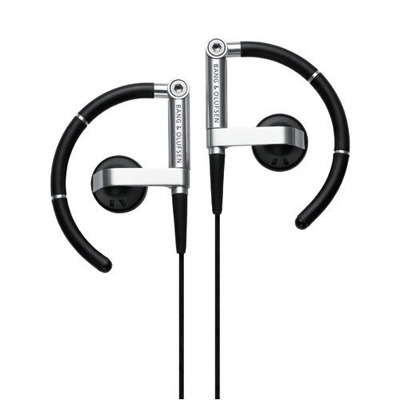
  1. Bang & Olufsen A8.  Since I had poured hundred of sheckles on the Shures, I figured ‘why stop’.  A few hundred dollars later I got the classiest earbuds I could find.  They hang on the ear so they won’t fall out every thought they are heavy.  You will not be able to wear sunglasses with these, the over-ear part is too thick.  The foam around the speaker is not meant for sweaty surfaces, but it works.  These lasted over a year.  The bad: They failed possibly due to the way I wound up the wire and put them in my pockets.  One side went out intermittently, putting the wires in a bind and they worked for another few months. 

Figure 4 B&O A8

  1. Motorola Bluetooth Headset, Wires failed me, so I tried wireless.  I recall these were on a crazy sale, so I tried them.  That was dumb.  The bad:, they are a vice pinching the softest part of your body, (the pinna).  Instant headache! And they bounce like crazy.  Buy these for people you do not like.
Figure 5 Motorola S10

  1. Yurbuds Ironman, Yurbuds expanded to making a headset.  I bought the ones called ‘Ironman’.  The box told the story of their invention, an athlete could not find a headset that worked, they all failed or bounced around, etc.  It was telling MY story.  I wept with joy and knew my search was over.  I was wrong, they suck.  The bad: The over-ear part push your ears out very far.  I looked like Liv Tyler’s idiot brother who was cut out of the LOTR movies.  There were pause/play buttons and they stopped working after ONE run, the day I bought them.  I went back to the store and exchanged them as ‘defective’.  That set last ONE RUN!  I threw them out and chalked it up as me paying my stupid-tax. 
Figure 6 Yurbuds Ironman


  1. The Bowers and Wilkins C5, this is a high quality headset.  Its method of staying in one's ear is a outward spring tension pushing into the internal curvature of the ear.  It is a good solution and can be tweaked to handle running without any bouncing.  Good sound, stays in place.  The bad: buttons failed after months of use.  Not a bad life expectancy relativelty, but costs dollars per run.
Figure 7 B&W C5

  1. The Bose SEI2I, The ‘active’ version of their headset.  I left out the Sony/Seinheiser pieces of junk, but these are shaped the same.  They are the most comfy in-ear earbuds I have ever worn.  Interestingly, they come with a short cable, but an extension, so you choose between too short or too long. (?) They take a decent beating.  The FIRST set I had survived hundreds of consecutive runs (with and without sweat)!  The bad: Finally, a earbud that will stay in my ears, seem to survive my sweat, but I washed them once and the dryer’s heat melted the wire insulation.  I haven’t wash-tested every headset I have owned, but I have washed a few and MELTING?? Come on!!>?@#wtf!>!?1!1.  Needless to say, I was so mad at Bose (whose founder died today L ), that I bought another pair.  They lasted 6.00001months and now the buttons don’t work.  My ‘alien-blood’ sweat hath done it again.  I can pause/play, but the microphone and volume up/down are inoperable.  Two pairs, about 1.5years of service.
Figure 8 Bose Sei2i

Over $1000 spent, and the search continues 


Sunday, April 7, 2013

First Real Run in B2R Trail Shoes


Using the new B2R Trail Shoes:
 photo 983D4EF4-AF3B-4B5A-B3DF-B46D330B0803-9413-000005F3D938B539_zps3aa34565.jpg
I see these peaks out of my kitchen window:  (peak on the left index finger, smaller summit with a house on it, then the top of the Incline Trail.)
 photo FA408E19-5A6A-4C48-9FBC-04380B10D7FD-9454-000005F4ADE2693E_zps77dfab5d.jpg

So I make it up to that First Peak: (looking down at my house)


Then I run to that house on the shorter peak.  Most of the time I feel like i'm following a trail, but I keep losing it.  I eventually end up on a driveway, I zig zag that dirt road for a while, finally just bound / bushwhack down a loose gravel/dirt hill, run on a paved road until I find another dirt trail!  Then I head to a geometrical shape I see on a neighboring peak.  Looks like a pill box or something.  Along the way I find a lantern, seems old.  The 'pill box' turns out to be a torn down house's foundation.  And after visiting it, I see it's the 'end' of the red mountain trail.


The shoes did GREAT.  I have not taken them through water crossings yet.  but the way the dust sifts through, you can tell they will drain quickly (and therefore dry quickly).

 photo 8A676C11-5317-4587-9E42-166392DB150E-9454-000005F486931951_zps6eaaaca5.jpg

I did have to stop a couple times to pull out cactus needles from my foot.

Wednesday, January 30, 2013

Are You Ready to Go Minimal?

Jay Dicharry the author of:
  

Weighs in on criteria conditions needed to try out minimal shoes using mobility test (with nice fixes to improve), muscle isolation, leg-stance balance, posture alignment.  It's a great 7mins, if you dig his stuff, buy the book for more.


Note... Even after practice, I can NOT stand on one foot with my eyes closed, I tip over as if pushed!  Let me know if you can do it!

Saturday, January 5, 2013

Overuse Injuries


Oh how i enjoy taking two sides of an issue to see which explanation is the more supportable (it's a science thing).  Sometimes the counterintuitive explanation is the correct one.  Knowing this, and knowing 'words have meaning' - we enjoy picking apart words, diagnoses, explanations, etc…

We can't help but chuckle when hear the term "overuse injury" used to 'describe' running injuries.  In googling it (in quotes) gives you about 83,500 results.  The top 3 are definitions.  

sportsmedicine.about.com  Definition: Chronic pain and injury refers to the sort of physical injury, ... are sometimes referred to as cumulative trauma or overuse injuries. 
emedicine.medscape.com  Overuse injuries, otherwise known as cumulative trauma disorders, are described as tissue damage that results from repetitive demand over the course of time. The term refers to a vast array of diagnoses, including occupational, recreational, and habitual activities. 
http://medical-dictionary.thefreedictionary.com/ Overuse injury
Sports medicine A sports- or occupation-related injury that involve repetitive submaximal loading of a particular musculoskeletal unit, resulting in changes due to fatigue of tendons or inflammation of surrounding tissues; OIs include tennis elbow and golf elbow. 

From emedicine: "cumulative trauma" sounds more like blows from a hammer than feet landing on the ground doing something as natural as running.  We assumed these definitions might be silly because it is so common to describe running as feet slamming on the ground, or pounding the pavement.  But obviously, some of us realize running has been with humans for millions of years - an adaptation used to survive.  Running is as natural to humans as breathing, or the muscles used to balance or stand; or having a beating heart.  These are muscle contraction too and not likely to hurt or be sore due to 'overuse'.

If you've been running non-stop since childhood with a form that is natural to the variable compliances of the muscles and tendons at your natural cadence with appropriate protection yet proprioception- we DOUBT seriously that you'll have an injury from overuse!!  It's more aptly an issue of underuse.

An explanation or diagnosis of an injury, condition, whatever must have the distinction between proximal cause, ultimate cause, fundamental cause.  There are chains of causes some proximal, some ultimate.  Some medical professionals have fancy terms for things that nothing more than a regurgitation of the symptoms.  " i have pain in my foot arch"  "oh you have plantar fasciitis"   which is what you said to them!  

Example: 
I am hurt due to an inflammation of a tendon, that's proximate.  The tendon is inflamed because of a muscle imbalance, that's an ultimate cause.  There is a muscle imbalance because of a form issue, biomechanics, leg length discrepancy, neuromuscular disconnect, or simply NO feedback mechanism of your bad form due to your overly cushioned shoes.  
Think about it, and don't settle for lame diagnoses.  

Sunday, November 25, 2012

Footwear Trends: Should Sport & Fitness Enthusiasts Embrace the Minimalist Movement?


Link Here:


Footwear Trends: Should Sport & Fitness Enthusiasts Embrace the Minimalist Movement?

ISSN: 1543-9518


ABSTRACT

The popularity of the barefoot movement in sports and fitness activities has soared within the past few years as evidenced by a growing community of minimalist
footwear enthusiasts wearing the ‘glove’ shoes in their sporting endeavors, fitness workouts, and everyday leisure activities. This emergence
of the minimalist shoes, such as the Nike Free© and Vibram FiveFingers®, has created a wave of intrigue for those sport and fitness enthusiasts wanting
a natural running experience without being subjected to the hazards of the road. Whether running barefoot, in shoes or in minimal footwear, the trends in footwear
preference have caused much debate between researchers as to which form causes more injuries and/or best serves to enhance athletic performance. As sport and
fitness professionals, it is important to thoroughly examine the current footwear trends to develop a ‘best practices’ approach for advising our athletes
and clients.
Click above link for entire article.  It is a great summary of minimalist footwear.

Wednesday, September 12, 2012

Ticking Time Bomb, How Children's Shoes Cause Problem Later in Life


15
MAY/11
Off

Ticking Time Bomb, How Children's Shoes Cause Problem Later in Life
What's wrong with this photo? Plenty! The young boy's shoes will screw up his gait and cause muscle imbalance. And he's stretching!
by Dr. Phil Maffetone
Twenty years ago, a review of shoes and gait in the journal Pediatrics outlined some key factors that affect children’s feet. Pediatric orthopedist Lynn Staheli, M.D., from the Children's Hospital and Medical Center, Seattle, Washington, listed these important points:
1.) Optimum foot development occurs in the barefoot environment.
2.) Stiff and compressive footwear may cause deformity, weakness, and loss of mobility.
3.) The term "corrective shoes" is a misnomer.
4.) Shoe selection for children should be based on the barefoot model.
5.) Physicians should avoid and discourage the commercialization and "media" obsession with faddish footwear.
6.) Merchandising of the "corrective shoe" is harmful to the child, expensive for the family, and a discredit to the medical profession.

The Nike V Infant toddler shoe.
Perhaps the most offensive aspect of the footwear industry is the harm it deliberately inflicts upon unsuspecting children by encouraging them to wear bad shoes. Between the twin forces of television and parental encouragement, little Johnny or Jill are defenseless. In particular, there's the potential damage to the young developing body and brain. And, this could be a primary cause of physical imbalances, injury and disability and later as adults.
It was evident from Dr. Staheli’s article that shoe companies in 1991 were already heavily marketing unhealthy children’s shoes, playing on the parent’s emotions and those of older children. Today, shoe companies continue to use clever million-dollar advertising campaigns to encourage kids to ask for, and parents to buy, harmful shoes. And it’s obviously successful. The U.S. children’s footwear industry, which includes shoes for kids up to 16 years of age, generates over $5 billion annually, where products are made for cuteness and style rather than function.
What’s the best shoe for your child? None—barefoot is best and nothing comes close. Children should be barefoot, most, if not all the time. This provides the optimal stimulation of the foot by the ground, which helps train the brain for proper gait and other natural movements that children require from the start.
When a shoe becomes absolutely necessary, Dr. Staheli says it should be lightweight, flexible, shaped more or less quadrangularly, and should not have arch supports and stiff sides. She says that pediatric orthopedists strongly oppose "corrective" or "orthopedic" shoes for straightening foot and leg deformities like flat feet, pigeon toes, knock-knees, or bowlegs, claiming there’s no evidence that these so-called therapeutic shoes are effective. Instead most of the supposed deformities in children naturally correct themselves. How you might ask?
Being barefoot is the best way for that to happen. Most healthcare professionals who properly understand a child’s body mechanics know this. (Yet there are many “experts” who recommend the regular use of shoes for young children, but they are usually aligned with the shoe industry or companies making orthotics and other corrective devices.)
Any shoe has the potential to seriously disturb the gait of a young child. His or her sensitive feet sense footwear much more than the adult foot. Even relatively minor pressure on a child’s foot from a shoe can begin deforming it, leading to a permanent problem.

During the first year following the acquisition of independent walking, most of the child’s gait activity, in particular, the neurological memories—the communication between brain and body—becomes well established.

Barefoot is best for children.
During this time, if the feet are not allowed to develop well, gait and balance disorders begin to occur. In many children, these irregularities are often subtle (the “clumsy kid”) while others more serious such as increased vulnerability to physical injury and various neurological imbalances anywhere in the body, including those associated with eye movement.
The full development of a child’s balance and compensatory mechanisms, and overall gait mechanics, takes years to mature. While the first five years of life are most delicate, neuromuscular interference from footwear can occur at any and every stage along the way into early adulthood. This can lead to more serious and chronic physical imbalances later in life, such as a running injury or back pain, and even amplify the stress caused by imperfect shoes.
Earlier this year, Caleb Wegener, Ph.D., and colleagues from the University of Sydney, Australia, reviewed the problems associated with a variety of different shoes worn by children for walking and running. Their study, published in the Journal of Foot and Ankle Research, states that, “Shoes affect the gait of children. With shoes, children walk faster by taking longer steps with greater ankle and knee motion and increased tibialis anterior activity. Shoes reduce foot motion and increase the support phases of the gait cycle. During running, shoes reduce swing phase leg speed, attenuate some shock and encourage a rearfoot strike pattern.” In short, these are some of the specific items that are a recipe for physical and neurological disaster, and the start of a process of chronic injury and disability that could last a lifetime.
These researchers noted Dr. Staheli’s 20-year old suggestion that shoe design should be based on the barefoot model. But some of the shoes they tested were designed on these principles and still caused gait irregularities in children. 

The researchers also state that, “Further attention could also be paid to reducing the weight of shoes which may be responsible for some of the [abnormal] changes found in children’s walking and running gait.” (It’s interested that this type of “free” information is available to shoe manufacturers but may never be utilized—instead, they test their shoes on machines, not real people.)
Among the untold problems that wearing shoes can impose in the developing child is the impact on the brain. From a baby’s very first delicate steps, each walking and running gait pattern significantly influences brain development. These actions affect lifelong patterns in the nervous system, even beyond the gait and balance mechanisms—they include postural habits, the ability to compensate to physical stresses, and the growth of muscles, bones, ligaments, tendons and other tissues. Normally, with each muscle contraction and relaxation, and every joint movement, important neurological patterns are created by the brain, just like with any memory. Shoes distort this process, and instead, the brain learns and designs irregular patterns of movement throughout the body.

Most childen's shoes are health hazards. It's like handing them "smokes"-- which is what candy companies did for many years.
In addition, other areas of the brain can be impaired. Normally, during early development in children, all the important neurological input from body movements trigger increased blood flow throughout the brain. This brings in oxygen and many other necessary nutrients to promote growth and development in areas that include learning, speech, and memory. Without the natural muscle contraction in the feet, for example, especially in the very small immature muscles that move the toes, impairment from wearing thick, oversupported modern shoes can reduce the brain maturing process.
In children plagued with posture- and gait-related problems, avoiding wearing shoes is even more important. This can help stimulate the above-mentioned neurological functions, which can, in itself, be very therapeutic. Rather than attempting the use of “corrective” shoes and related devices, such as inserts or braces, finding and correcting the causes, including  neuromuscular imbalance, is important.

Many physical ailments in adults could begin at this young age. Think about all the physical problems you’ve had in your life—it’s possible that many began during development of the important brain-body mechanisms due to significant interference by shoes.
It seems silly to even be discussing the issue of children’s shoes. Most people don’t question the fact that eating junk food is bad for kids, or smoking cigarettes. The level of brain and body stress from wearing bad shoes can be just as damaging. The most logical, effective, and healthiest way for children to develop their whole body is by being barefoot.
This essay originally appeared on Dr. Phil Maffetone's website. For more information on the do's and don'ts of children's shoes, Dr. Mark Cucuzzella has a lot more on the kids page on hisTwo Rivers Tread website. 

Wednesday, August 22, 2012

Foot Strengthening by Mobility WOD

K Star and Brian fly through these mobility movements that are great lower leg looseners.  Watch this video a few times to get the gist, and find your own nightly mobility movements that work for you.  

Wednesday, August 15, 2012

Crossover Gait

Just be more stable!  The first time I considered where (in relation to our hips) our feet should fall is while watching "Running the Sahara".  In this documentary, the elite, amazing runners complained that in running in the desert, they would frequently have to run in the tire track of the support vehicle.  That meant their feet would follow a narrow line and that was contrary to their normal running style.  That comment rang in my head while i'd run i'd purposely "straddle" sidewalk seams to ensure my feet landed below the hip sockets from whence they sprout.   

I know my efforts in a slightly wider landing led to my 5km PR - there are indisputable torsional benefits gained by not crossing over. 

Walk on a piece of string or along a seam in the concrete or walk on the lane dividing lines on your local high school or college track. What happens ? If you walk on a single line you will find yourself more unstable as compared to walking with a foot fall directly under your hips and knees the way it is supposed to occur. The limbs are a pendulum and economy and biomechanical efficiency as well as injury reduction will occur when the parts operate in the most effective manner.
We have all of our cross over runners, as you see her doing in the first half of this video before she corrects to anti-cross over (ie. natural), first walk on a line. In our case we use the metal drainage grate outside our office that you see in the video for just that purpose, they walk the grate. Then they run the grate. We ask them to feel ....... want to read the rest ? head over to our blog here for the entire article.

http://thegaitguys.tumblr.com/post/29486393822/the-cross-over-running-techniq...


Here are the other related cross over links here on youtube:
Part 1: http://youtu.be/LG-xLi2m5Rc
Part 2: http://youtu.be/WptxNrj2gCo
Part 3: http://youtu.be/oJ6ewQ8YUAA

^^Thanks Gait Guys for articulating what I had to learn the hard way :)


Friday, August 10, 2012

B2R Shoes, yay! (First Look)

I was happy when my former running coach, Eric Orton, said he had a line of shoes coming out.  Eric taught me the importance of cadence, running economy, running-specific leg, core and glute strength (in other words, everything I know).   I am all ears when Eric suggests a shoe, so him 'making' a shoe! Even better!  <<--in summary, I had high expectations.  

The first Born2Run shoe is road shoe available in red or flourescent yellow.  The zero drop (0mm heel to midfoot differential) has become a requirement for running shoes for me.  The shoe is very lightweight at about 7ounces, comparable to Merrells or the latest Vibrams.  When I saw the stack height I feared there would be little ground feel.  The split toe, or cloven sole, seemed novel.  I have Vibram five fingers and Zem Gears so I'm no stranger to having things between my toes.  


Image and video hosting by TinyPic
I chose a true to size for me.  Sizing is a little bit of a science to me.  It's not about where your toe lands in the front of the shoe, it's about lining up the flexible part of the shoe with the flexible part of your foot <see pic>.  My toes' bend lines up with the natural bend in the shoe (as measured from the heel) perfectly.  <In summary the distance from your heel to your toes' hinge point should match the hinge point of the shoe>.  Fortunately, in this case, this shoe is flexible enough that if you're off a bit it won't matter.  

Putting the shoe on I first noticed how thin the material between my toe was!  It was unnoticeable.  As is explained repeatedly on mobilitywod.com, the gap between my big toe and the rest of my toes gets bigger as my feet get stronger - the cloven shoe helps with that.  Some people with weaknesses or tightly crammed toes may not find this as natural a fit as I did.  I then noticed even though the stack height is tall, the material is thin enough that I had great ground feel.  I could tell if I was standing on a quarter.  The shoe comes with two pairs of tabi socks, so i paired them together.  I then tried my injinji toe socks and found them to also be a great fit, unobtrusive even.  

My first day of wearing them, I took them though a crossfit workout that included box jumps, rope climbs, weightlifting, and running with weights.  The shoe performed very well and didn't slip when sweaty. In fact, the upper gripped the rope well!  The shoe also gave good lateral stability and didn't roll across my foot the way Softstar runamocs, or Zem Gears do for such workouts.

So far I have run in them on paved trails, roads, sidewalks and track for 5-9 mile runs.  My feet felt a little tight post-run; I think I'm calling upon more foot muscles with these shoes than I need for my Merrell trail gloves.  Whenever I feel sore, I'll change shoes the next day and swap back and forth.  I haven't needed to do that in my B2Rs.  I've ran with them for 4 days in a row and counting, hill repeats, hard intervals, recovery.  All good!  

Fit, ground feel, flexibility are all A+.  No seams inside to annoy me, achilles tendon guard is low and flexible.  Can not be improved.  My two tiny complaints: 
Image and video hosting by TinyPic

a.) my laptop cable has once gotten caught in between the toe seam! I took a couple steps and yanked the cord out (thank goodness it was a Mac - magnetic connector!)


b.) this little liner at the bottom worked its way out of the shoe as I ran! <see pic> it was travelling up my heel during my speed workout day.  Funny that i'll blame the shoe, although it's probably my form - my problem!  ;)

I look forward to beating these shoes up some more and talking more about their longevity. 

Below is a quick, unnarrated vid showing the difference in heft and flexibility between the Brooks True Grit and the B2R Road shoe.  Notice the True Grit's split toe is really artificial, just a slice in the tread.  


Friday, July 20, 2012

Take Control of Your Cadence

You need to be the boss of YOUR cadence, don't let it be controlled by someone that's not you! I noticed sites like these (Link Here) are popping up to sell you songs in an effort to better control your running.  Their web site claims this:  


_________________________________________________________________________________
Header Technical

Linking BPM to Running Speed


How to work out which BPM to choose: The run2rhythm program is essentially coupling running cadence to music.
With running, very few people can sustain a steady rhythmic pace over an extended period. Many tend to start too fast and don’t get to finish the distance intended, or within the time targeted for the run. The run may not last as long as they intended…..”puffed out early!”


Outdoor running:

  1. Run for 15 minutes at a pace you are comfortable with
  2. If you are starting out this will be slower than if you are a conditioned runner.
  3. During that run count your steps for 1 minute. Do this several times to get an average.
  4. Then, refer to the chart below to determine the BPM you should choose.
________________________________________________________________________________


I think in their description they're smearing cadence (steps per minute) and running speed.  In a car you've got tachometer and speedometer, tach measure cadence of engine, speedo is mph of vehicle.  Like running in place is steps / min and 0 mph.  To extend my analogy too far ... a pump is an engine (like a car engine) that runs at one rpm all day.  A pump's engine's rpm was chosen to be at it's peak efficiency.  Running is much the same way.  There is little reason to deviate at ALL from YOUR personal efficient cadence when endurance running.  


What is 'my' natural cadence?  My resonance?  Well it depends, but not by much!  You can experiment by just hopping in place (two foot hops to start with) like you're jump roping. Start out springing up once a second.  You'll notice that's so slow that the spring energy you loaded on your tendons dissipates before your next hop.  Try two hops per second boing-boing-boing, you should notice that some energy is stored then released to help you spring back up.  As a boundary condition try hopping as fast as you can.  It's WORK!  A typical figure to work with is 180 steps per minute (aka 90 strides per minute).  If you want to synch that up to music or an audio metronome (many apps available for phones, or search metronome on amazon.com).  


I treat 180 spm as a MINIMUM.  If you're running there is no good reason to allow that stored elastic energy to dissipate, use it for your next stride and it doesn't hang around long!  ;).  An interesting test is to search for your maximum.  Fun thing to try at a track, do a series of 200m with rests each one increase a few strides per minute.  After 205-210 it's really hard to keep up.  What's your max?


Note: if you are synching up to music or beats, treat each beat as a foot LIFT, (not foot fall) otherwise you'll find yourself planting your foot unnaturally hard.  


Enjoy and let us know how it goes!

Wednesday, March 14, 2012

Stretching out plantar fasciitis

Sing Song: "The Hamstring's connected to the Fascii"  great Video on the subject, click here

 Summary:  “After controlling for covariates, participants (86 of 210 feet) with hamstring tightness were 8.7 times as likely to experience plantar fasciitis (p < .0001) as participants without hamstring tightness. Patients with a BMI >35 were 2.4 times as likely as those with a BMI <35 to have plantar fasciitis.”

Stretching out plantar fasciitis


www.shutterstock.com #6522286
By Katie Bell 
Tight hamstrings play an important role in plantar fasciitis, according to a study published in the June issue of Foot and Ankle Specialist.
“These findings show that while we always consider the tightness of the gastrocnemius/soleus complex and the subsequent restricted ankle motion from this equinus, we also need to consider the role of the hamstrings,” said Jonathan Labovitz, DPM, lead author and associate professor at Western University of Health Sciences, Pomona, CA.
The prospective cohort study included 105 participants (210 feet); 79 had plantar fasciitis, which researchers assessed with palpation, who measured popliteal angle with a tractograph and diagnosed ham­string tightness when the popliteal angle ≤160°.
Without controlling for covari­ates, body mass index (BMI), tightness in the hamstring, gastroc­nemius/soleus, and gastrocnemius, and the presence of a calcaneal spur all had statistically significant associations with plantar fasciitis.
After controlling for covariates, participants (86 of 210 feet) with hamstring tightness were 8.7 times as likely to experience plantar fasciitis (p < .0001) as participants without hamstring tightness. Patients with a BMI >35 were 2.4 times as likely as those with a BMI <35 to have plantar fasciitis.
Researchers at Cappagh Orthopedic Hospital in Dublin, Ireland, first linked hamstring tightness with plantar fasciitis in a study published in the December 2005 issue of Foot & Ankle International. The Western University researchers now suggest that an increase in hamstring tightness may induce prolonged forefoot loading and, through the windlass mechanism, may be a factor that increases repetitive plantar fascia injury.
Triceps surae tightness was not included in the Western University covariate analysis, raising the possibility that hamstring tightness was not actually the cause of plantar fasciitis in patients wth tightness in both areas.
“People who have tight hamstrings are more than likely going to have a tight triceps surae,” said Michael T. Gross, PT, PhD, a professor in the Division of Physical Therapy at the University of North Carolina in Chapel Hill. “The investigators of this study admitted that 96% of subjects who had tight hamstrings also had tight triceps surae. Now there’s a cause and effect. If you can’t get dorsiflexion at your talo-crural joint, this often drives dorsiflexion at other joints and that is going to cause collapse of the longitudinal arch of the foot, loading the plantar fascia with increased tensile stress.”
In people with hamstring and triceps surae tightness and plantar fasciitis it’s not known whether the ankle equinus from a tight triceps surae causes hamstring tightness or vice versa, Labovitz said.
“There is no question that the tightness of the triceps surae will cause flattening of the arch and increase tensile stress on the plantar fascia,” Labovitz said. “The question becomes, are the hamstrings involved in this and, if so, to what effect?”
The timing of plantar fascia loading and hip kinematics during gait raise additional questions about pos­sible hamstring involvement, Gross said.
“When loading is taking place at the plantar fascia, it’s mid to late stance. At mid to late stance, the hip is in extension and even hyperextension.  Even though the knee is extended, extension/hyperextension at the hip will limit the amount of passive tension that could be developed in the hamstrings, so it is a mystery to me how tight hamstrings would cause trouble for the plantar fascia,“ he said.
Labovitz suggested, however, that a little hamstring tightness might go a long way in influencing the plantar fascia.
“The practical application is that since the hamstrings have been shown to be involved and possibly have more influence than equinus due to the longer lever arm, showing greater effect on the flattening of the foot and plantar fasciitis, less restriction is necessary to have the same effect as equinus,” he said.
The researchers suggest that treatment of plantar fasciitis should address hamstring tightness along with equinus and obesity. Night splints, orthoses, and gait retraining have been shown to be effective for managing plantar fasciitis pain but will not address hamstring flexibility, Labovitz noted.
“The hamstrings should be examined and treated,” Labovitz said.  “Stretching is the best treatment for increasing flexibility.”