Wednesday, October 9, 2013

Gluten Free Food List

Gluten Free Food List

Gluten Free Food List (Dr Perlmutter, get his 'Grain Brain' book)

The following items can be consumed liberally on your Gluten Free Diet (go organic and local with your whole- food choices wherever possible; flash frozen is fine, too):
  • Healthy fat: extra virgin olive oil, sesame oil, coconut oil, grass-fed tallow and organic or pasture-fed butter, ghee, almond milk, avocados, coconuts, olives,nuts and nut butters, cheese (except for blue cheeses), and seeds (flaxseed, sunflower seeds, pumpkin seeds, sesame seeds, chia seeds).
  • Protein: whole eggs; wild fish (salmon, black cod, mahi mahi, grouper,herring, trout, sardines); shellfish and molluscs (shrimp, crab, lobster, mussels, clams, oysters); grass-fed meat, fowl, poultry, and pork (beef, lamb, liver, bison, chicken, turkey, duck, ostrich, veal); wild game.
  • Vegetables: leafy greens and lettuces, collards, spinach, broccoli, kale, chard, cabbage, onions, mushrooms, cauliflower, Brussels sprouts, sauerkraut, artichoke, alfalfa sprouts, green beans, celery, bok choy, radishes, watercress, turnip, asparagus, garlic, leek, fennel, shallots, scallions, ginger, jicama, parsley, water chestnuts.
  • Low-sugar Fruit: avocado, bell peppers, cucumber, tomato, zucchini, squash, pumpkin, eggplant, lemons, limes.
  • Herbs, Seasonings, and Condiments: You can go wild here as long as you watch labels. Kiss ketchup and chutney goodbye but enjoy mustard, horseradish, tapenade, and salsa if they are free of gluten, wheat, soy, and sugar. There are virtually no restrictions on herbs and seasonings; be mindful of packaged products, however, that were made at plants that process wheat and soy.
The following can be used in moderation (“moderation” means eating small amounts of these ingredients once a day or, ideally, just a couple times weekly):
  • Non-gluten grains: amaranth, buckwheat, rice (brown, white, wild), millet, quinoa, sorghum, teff. (A note about oats: although oats do not naturally contain gluten, they are frequently contaminated with gluten because they are processed at mills that also handle wheat; avoid them unless they come with a guarantee that they are gluten-free.) When non-gluten grains are processed for human consumption (e.g., milling whole oats and preparing rice for packaging), their physical structure changes, and this increases the risk of an inflammatory reaction. For this reason, we limit these foods.
  • Legumes (beans, lentils, peas). Exception: you can have hummus (made from chickpeas).
  • Carrots and parsnips.
  • Whole sweet fruit: berries are best; be extra cautious of sugary fruits such as apricots, mangos, melons, papaya, prunes, and pineapple.
  • Cow’s milk and cream: use sparingly in recipes, coffee, and tea.
  • Cottage cheese, yogurt, and kefir: use sparingly in recipes or as a topping.
  • Sweeteners: natural stevia and chocolate (choose dark chocolate that’s at least 70 percent or more cocoa).
  • Wine: one glass a day if you so choose, preferably red.

Here’s a sample shopping list:

  • Shredded Coconut
  • Kale
  • Almonds
  • Walnuts
  • Olive Oil
  • Coconut Oil
  • Grass Fed Beef
  • Free Range Eggs
  • Avocado
  • Free Range Turkey
  • Free Range Chicken
  • Mixed Greens
  • Spinach
  • Broccoli
  • Wild Salmon
  • Berries (in moderation
  • Onions
  • Garlic
  • Bell Pepper
  • Black Pepper
  • Goat’s Cheese

Thursday, October 3, 2013

Quick snapshot of diet with rationale

I occasionally do a Livestrong.com/myplate daily food log as a sanity check to see where my macronutirents (protein, carbs, fats) are.

The pie chart is my ratios for what I've been consuming lately.


Typical day:

  • Morning: MCT Oil in coffee (1-2Tsp)
  • Late morning: 3 Soft boiled eggs (preserve the yolks!), 3 strips bacon
  • Before noon: lunch leftover bison, potatoes, carrots in its broth
  • Evening 2 handfuls of nuts
  • Dinner: Ground Lamb, sweet potato, brussel sprouts scoops of coconut oil
It's very simple diet, so easy to maintain.  

Carbs: You'll laugh but the carbs are almost exclusively through beer. Other carbs include a few cups of sweet 'taters, brussel sprouts, broccoli, spinach

Protein: is a necessary evil that comes with my search for fats. 

Fats: I seek meats, lamb and bison preferred. Secondary sources are steak/chicken. handfuls of nuts, and scoops of MCT oil, coconut oil (in coffee, on veggies), and guac. eggs every morning, sometimes bacon.  Lamb and bison are 'always' grass- fed. Corn fed steak is 'ok'. Grass fed steak is either expensive as balls or hard to find... as balls. Chicken has little to offer, it is a filler food that is benign. I seek seafood once a week. Fatty fish of course (=cold water) like salmon. Problem is most salmon is raised in shitty water and fed soy.  


Wednesday, October 2, 2013

Night time running

For those of us on Northern Hemisphere daylight is becoming a more scarce resource.  Besides a reduction of Vitamin D* we are also now visually impaired and not easily seen by others. Gotta stay safe: Need to see and be seen.  Buying a lighting system is the type of purchase you want to get right the first time.  Nothing is more expensive than buying something that you never use.  Two reasons for lighting:
  • Light your way
    • Night Trail Running: There are typically no street lights on trails.  Looking for a lighting system with more than 100 Lumens is a safe rule.  
    • Black Diamond 80-100 Lumens
      Headlamps are a good solution. They leave your hands free and only cast light where you're looking.  They can be inconvenient if you're used to wearing a hat, and the pressure on the forehead can take some getting used to.  It would be nice if they were lined with a Richard Simmons terrycloth head band - alas, there always seems to be some plastic digging in to your forehead. 

    • Night Road Running: In the presence of some street lighting and possible traffic, it's more important to be seen by others.  For this you'll need a handheld flashlight that you can point low, looking for road hazards and curbs and not blinding drivers or other pedestrians. A handheld is also appropriate for encountering other nighttime runners in populated areas.  The major benefit of handheld is that they allow you to avert your lighting without having to avert your gaze.  Another secret...keep one eye closed when around a car's headlights (and don't look directly into the headlights - no brainer?), this keeps the pupil in the closed eye big for better night vision later ;)
  • Be seen by others
In the presence of nighttime traffic (even dusk), wearing reflective clothing and carrying battery powered glowsticks and blinking red lights all help you be more visible to the half-blind drivers out there.  Quote from Evaluation of Reflective Vest Options 
"Research on human perception (in motor vehicles) finds that drivers must first notice, and then identify, an object (in or near the roadway) in order to react to it (Beck2  2005, and Ashton 2007). Police uniforms are typically dark colored and even more difficult to see at night. The white shirt common among higher ranked officers does not add to their visibility in low light or nighttime conditions. Beck, citing research conducted in 1984, notes a driver at 30 miles per hour (mph) detects a subject in dark clothing at approximately 70 feet (giving the subject approximately 1.5 seconds to react). If the speed is 55 mph, the reaction time was under one second. Similar research by the University of Michigan Transportation Research Institute (as cited by Ashton 2007) concluded that in a simulated work zone, a driver detected a person in non-reflective clothing at 125 feet while they detected an individual in reflective clothing at 891 feet."


7 times further reaction distance is the difference between reflective and non-reflective clothing.  That's pretty good odds for a low cost inVESTment.  One ebay search shows as low as $5 could protect you.  Search here.


Flashlight with a pivot-able head


Selecting a headlamp or flashlight (or as I do it, one each): Think about battery replacement (rechargeable or not), comfort, lighting-power, and ergonomics. When using a flashlight, the angle of your hand is important. Over time, pointing a flashlight can be an uncomfortable if you need to maintain an unnatural wrist angle. Knuckle lights, or an aim-able flashlight head can make things more comfortable.
Knuckle lights


My solution, I wear a headlamp that has a blinking red light in the back and carry a stronger handheld. Because I'm a nerd I chose a 'programmable' flashlight.  I can get it to blink fast to remind me to do pickups at time intervals, or blink slow to remind me to turn around and run home.  If you're the type to think a programmable flashlight may be fun, here's an example of one:

www.hexbright.com
Be safe.  Buy quality stuff!  Torches would be more paleo (and more fun for the pyros among us), but it just makes your neighbors a little suspicious.  I'd love to hear what your lighting solutions are, what worked, and what did NOT work.

**The way to NOT be vitamin D* deficient (or A,E,K,etc) is high cholesterol diet rich in fats. Lead a fat burning lifestyle to get the most bang for your food buck.

Saturday, September 28, 2013

Great video, get the skinny on eating fat


"We don't have the luxury of time to find the truth before making policy…"


-The McGovern Report 


(the report that to this day affects what you eat, and has done a bang-up job on fixing diet related non infectious diseases, eh?)

An informative dietary lesson from history here:

http://vimeo.com/45485034

wonderful research explained like this:


Check it out if you have any concerns with how you look, feel, perform, and track health markers. 

Thursday, August 15, 2013

Paleo vs. Vegetarian Diets; Fats vs. Carbs


Article below from the latest Trail Running Mag.  We (humans) get used to what we're exposed to.  For example, in one generation, low nutritionally dense foods that are falsely flavored to make them palatable has become the norm.  Two diets that make an attempt to diverge from this norm are vegetarian and paleo.  Since we do not have an extra ruminant stomach to ferment veggies and grains, paleorunners tend to lean towards paleo.  Besides having one stomach, there also is the issue of carb-dependent or fat-dependent for fueling during a run.  One convenient thing about being fat-dependent - we already carry fat with us.

another compelling point about deciding whether to eat high fat of low fat, simply look at micronutrients.  There are two kinds water-soluable and fat-soluable, wait... no carb-soluable?  How do carbs help me absorbs vitamins and minerals?  They don't. 

Good quote form the article below:
"As you become more aerobically fit, your body becomes more efficient at using its existing fat stores as fuel. The ability to burn fat stores efficiently not only improves endurance capacity by sparing glycogen, but also reduces the need to rely on eating carbohydrates or fat during a run, which decreases the risk of intestinal distress and a consequent decrease in performance."

Paleo vs. Vegetarian Diets; Fats vs. Carbs

Ask the Dietitian: Finding the best fuel


alt
Vegetarian and Paleo diets seem to be equally popular and totally at odds.Is there any nutrition science to support one over the other, or does it simply come down to personal experimentation and experience?
—Martin Miller, Helena, Montana
A vegetarian diet is devoid of red meat, poultry and often fish, but includes animal byproducts such as cheese, milk and eggs. Studies have shown that vegetarians live longer than their carnivorous counterparts because the diet is generally high in dietary fiber and low in saturated fat. There is a widespread concern that a vegetarian diet is deficient in protein, vitamin B12 and iron—all key nutrients for a trail runner’s well-being. However, by eating a varied diet with adequate calories, most people will find that they can easily consume enough of these nutrients, in the form of of leafy greens, fruits and vegetables, fortified cereals, whole grains, lentils, seeds and nuts.
In contrast, the Paleo diet consists of meat, fish, shellfish, poultry, eggs, vegetables, tree nuts, fruits and berries. The theory behind the Paleo diet is that the addition of grains, legumes and dairy to the human diet precedes and contributes to chronic diseases like obesity, heart disease and diabetes. The Paleo diet is low on carbohydrates, the MVP in a long-distance runner’s diet. In a previous Trail Runner article, the benefits of the Paleo diet for trail runners are highly praised by Joe Friel and Dr. Loren Cordain. In their book, The Paleo Diet for Athletes, these Paleo advocates have modified the diet in order to meet the needs of the modern-day distance runner. They say our ancestors “put in about 10 miles, which included walking, slow running and short bursts of speed.” There were also times when they went for days with no exercise. The modifications they suggest essentially throw out the Paleo rules prior to, during and after a race, hard workout or run longer than 10 miles. Friel and Cordain recommend that a Paleo athlete follow the same rules as other Non-Paleo athletes at these times by consuming foods rich in carbohydrates and fueling with traditional sports drinks, gels and energy bars.
Both a vegetarian and Paleo diet may inherently enhance runners’ health and performance by increasing consumption of nutrient-packed foods like fruits and vegetables over the typical American diet of processed foods, refined carbohydrates and sugars, but each diet carries its own risk for nutrient deficiencies, given there are major food groups excluded in each. Experiment with what you enjoy eating most and what foods help your body thrive in athletic performance. The goal is to have a well-rounded diet that is void of nutrient gaps and sufficient in calories to ensure that your body is getting everything it needs to train, race and recover efficiently. A nutritionist or dietitian can help you monitor for signs of potential nutrient deficiencies.

What is better for fueling a long run—fats or carbohydrates?
—Question paraphrased from similar questions submitted by several readers.
Carbohydrates and fats are a major source of energy for endurance athletes. Unfortunately, we only have about 2000 calories worth of glycogen, or stored carbohydrates, reserved in our muscles, liver and blood glucose. To prevent low blood sugar and its debilitating effects, consuming carbohydrates is necessary for runs or races that last longer than 90 minutes. The benefits of ingesting carbohydrates like maintaining proper blood glucose levels, delaying the onset of fatigue and preventing muscle glycogen depletion are well supported by decades of research with endurance athletes.
Because we have a nearly unlimited supply of calories from fat stores, it is unnecessary to replenish that fat during a run. In addition, most studies show that consuming fat while running does not increase fat burning or spare the use of glycogen. It takes more energy to process fat than it does to process carbohydrates. Any gain in calories would be lost and, because fat is slow to digest, there is a chance that it will lead to an upset stomach.
Medium-chain triglycerides (MCTs) are fats that are absorbed rapidly by the body and, like carbohydrates, are a quick source of energy. MCTs such as coconut oil are becoming more popular as an alternative to carbohydrates during ultra events to help satiate hunger and avoid flavor fatigue from an excessive intake of sweet gels and drinks.
As you become more aerobically fit, your body becomes more efficient at using its existing fat stores as fuel. The ability to burn fat stores efficiently not only improves endurance capacity by sparing glycogen, but also reduces the need to rely on eating carbohydrates or fat during a run, which decreases the risk of intestinal distress and a consequent decrease in performance.

Editor's Note: This is an installment in our online Ask the Dietitian column with Maria Dalzot, MS, RD, CDN and an avid trail runner. You can visit her blog at www.mariadalzotrd.com and submit your nutrition questions tonutrition@trailrunnermag.com.

Wednesday, July 17, 2013

Game Changing Moments, Tweet To #GameChanger

#GameChanger campaign

Social Media = sharing.  Here's a cool campaign to share YOUR game changing moment.  Corner stone, pivotal moment, game changer, disruptive impact-ful moment, etc.  What where when? share your personal stories and #GameChanger moments in life and sport that have changed your life for the better.   

Share your personal #GameChanger moment and story with us over Twitter - help inspire others!

Here is the link to the Challenge "Share Your GameChanger moment": http://bit.ly/110ee5o

Mine is:  Looking at ancestral clues for natural movements, resonances, and abilities. Using my body the way it was intended

Saturday, July 13, 2013

Earbuds, Not that Easy


earbuds  plural of ear·bud
Noun
A very small headphone, worn inside the ear.

As a runner I have tough requirements for earbuds. Here is a short list:

  1. stay in the ear even through running, this is where advice cannot be taken, get a set with multiple ear size fitments pieces
  2. sound isolation, a good fit in the ear will allow you to keep the volume down, your ears will relax and you will hear more of your earbuds AND outside sounds
  3. microphone, pause/play, volume up/down, the type of functions that come on earbuds included in the purchase of a smart phone.  The less you need to touch your phone while running, the longer it will last.  When I commute run I’m always talking or texting. 
  4. must survive my sweat.  This is not a feature that you can test in the store.  Simply being waterproof isn’t enough
  5. must survive the wash cycle, leaving them in your clothes should not be a death sentence

The above list seems do’able.  If we can put a man on the moon then we should be able to achieve this loftier of goals.  I have tried a few earbuds in my 4 years of running.  Here are a few memorable ones… (spoiler alert) the search continues.

  1. Iphone’s earbuds: all but iPhone Gen 2 have a wire insulation that will survive sweat.  The earlier models would not stay in my ears, but the company Yurbuds had a solution for this in Figure 2 Yurbuds.  The newer generation iPhone earbuds fit into my ear canals nicely, they survived running without falling out.  The bad: with my chemistry, the buttons and or microphone with every set of these earbuds has failed.  100%.  They will survive the winter months pretty well when there is enough clothing separating my sweat from their buttons.  Usually they fail by engaging the pause/play (which when held down wakes up Siri).  Music will pause/play on its own, calls ended, Siri asking what I want.  It is infuriating!
Figure 1 the iphone earbuds, every generation

Figure 2 Yurbuds which fit early iPhone earbuds

  1. Shure EC(all), I have tried E3c, E5c, and others.  Much improved sound quality, good seal to block out sounds and let your ears relax.  The bad: They will not stay in the ears.  The wire insulation gets hard/soft with temperature and they will fall out of your ears. I recall many not having the buttons and the wire so their functionality is sub par as well.
Figure 3 Shure

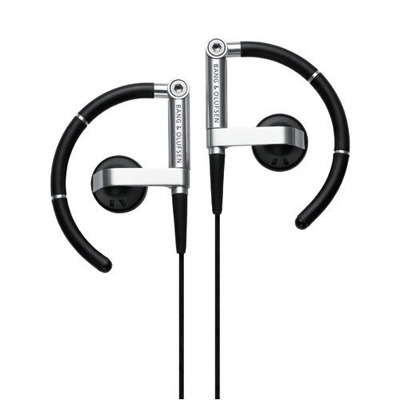
  1. Bang & Olufsen A8.  Since I had poured hundred of sheckles on the Shures, I figured ‘why stop’.  A few hundred dollars later I got the classiest earbuds I could find.  They hang on the ear so they won’t fall out every thought they are heavy.  You will not be able to wear sunglasses with these, the over-ear part is too thick.  The foam around the speaker is not meant for sweaty surfaces, but it works.  These lasted over a year.  The bad: They failed possibly due to the way I wound up the wire and put them in my pockets.  One side went out intermittently, putting the wires in a bind and they worked for another few months. 

Figure 4 B&O A8

  1. Motorola Bluetooth Headset, Wires failed me, so I tried wireless.  I recall these were on a crazy sale, so I tried them.  That was dumb.  The bad:, they are a vice pinching the softest part of your body, (the pinna).  Instant headache! And they bounce like crazy.  Buy these for people you do not like.
Figure 5 Motorola S10

  1. Yurbuds Ironman, Yurbuds expanded to making a headset.  I bought the ones called ‘Ironman’.  The box told the story of their invention, an athlete could not find a headset that worked, they all failed or bounced around, etc.  It was telling MY story.  I wept with joy and knew my search was over.  I was wrong, they suck.  The bad: The over-ear part push your ears out very far.  I looked like Liv Tyler’s idiot brother who was cut out of the LOTR movies.  There were pause/play buttons and they stopped working after ONE run, the day I bought them.  I went back to the store and exchanged them as ‘defective’.  That set last ONE RUN!  I threw them out and chalked it up as me paying my stupid-tax. 
Figure 6 Yurbuds Ironman


  1. The Bowers and Wilkins C5, this is a high quality headset.  Its method of staying in one's ear is a outward spring tension pushing into the internal curvature of the ear.  It is a good solution and can be tweaked to handle running without any bouncing.  Good sound, stays in place.  The bad: buttons failed after months of use.  Not a bad life expectancy relativelty, but costs dollars per run.
Figure 7 B&W C5

  1. The Bose SEI2I, The ‘active’ version of their headset.  I left out the Sony/Seinheiser pieces of junk, but these are shaped the same.  They are the most comfy in-ear earbuds I have ever worn.  Interestingly, they come with a short cable, but an extension, so you choose between too short or too long. (?) They take a decent beating.  The FIRST set I had survived hundreds of consecutive runs (with and without sweat)!  The bad: Finally, a earbud that will stay in my ears, seem to survive my sweat, but I washed them once and the dryer’s heat melted the wire insulation.  I haven’t wash-tested every headset I have owned, but I have washed a few and MELTING?? Come on!!>?@#wtf!>!?1!1.  Needless to say, I was so mad at Bose (whose founder died today L ), that I bought another pair.  They lasted 6.00001months and now the buttons don’t work.  My ‘alien-blood’ sweat hath done it again.  I can pause/play, but the microphone and volume up/down are inoperable.  Two pairs, about 1.5years of service.
Figure 8 Bose Sei2i

Over $1000 spent, and the search continues 


Friday, June 21, 2013

8 Foods We Eat In The U.S. That Are Banned In Other Countries


8 Foods We Eat In The U.S. That Are Banned In Other Countries

This brings a whole new meaning to the phrase “food poisoning.” Original list found in Dr. Jayson Calton and certified nutritionist Mira Calton’s new book, Rich Food, Poor Food.


1. Artificial food dye: Makes your food pretty and inhibits nerve-cell development.

Artificial food dye: Makes your food pretty and inhibits nerve-cell development.
Found in: Practically everything we eat: cake mixes, sports drinks, cheese, candy, and even MACARONI AND CHEESE.
Why it’s dangerous: Artificial dyes are made from chemicals derived from PETROLEUM, which is also used to make gasoline, diesel fuel, asphalt, and TAR! Artificial dyes have been linked to brain cancer, nerve-cell deterioration, and hyperactivity, just to name a few.
Where it’s banned: Norway, Finland, Austria, France, and the United Kingdom.
For more information on artificial dyes, visit 100 Days of Real Food.

2. Olestra (or Olean): Lowers calorie counts while causing vitamin depletion and anal leakage.

Olestra (or Olean): Lowers calorie counts while causing vitamin depletion and anal leakage.
Found in: Fat-free potato chips, corn chips, and French fries.
Why it’s dangerous: Created by Procter & Gamble as a substitue for cooking oil, Olestra robs your body of its ability to absorb vitamins. Fun side effects include cramps and leaky bowels.
Where it’s banned: The U.K. and Canada.
For more information on Olestra, visit Time magazine’s “50 Worst Inventions.”

3. Brominated vegetable oil: Makes food dye stick to liquid, but also may cause birth defects and major organ damage.

Brominated vegetable oil: Makes food dye stick to liquid, but also may cause birth defects and major organ damage.
Found in: Sports drinks and citrus-flavored sodas.
Why it’s dangerous: Bromine is a chemical used to stop CARPETS FROM CATCHING ON FIRE, so you can see why drinking it may not be the best idea. BVO is linked to major organ system damage, birth defects, growth problems, schizophrenia, and hearing loss.
Where it’s banned: In over 100 countries.
For more info on BVO, visit Web MD’s “Brominated Vegetable Oil Q&A.”

4. Potassium bromate (or bromated flour): Great for impatient bakers, bad for your kidneys and nervous system.

Potassium bromate (or bromated flour): Great for impatient bakers, bad for your kidneys and nervous system.
Found in: Wraps, rolls, bread crumbs, bagel chips, flat breads.
Why it’s dangerous: Derived from the same harmful chemical as brominated vegetable oil, brominated flour is used to decrease baking time and reduce costs. Only problem is, it’s linked to kidney damage, cancer, and nervous system damage.
Where it’s banned: Europe, Canada, and China.
For more information on potassium bromate, visit Live Science’s “The Truth About Potassium Bromate.”

5. Azodicarbonamide: Bleaches flour, plastic, and induces asthma as an added bonus.

Azodicarbonamide: Bleaches flour, plastic, and induces asthma as an added bonus.
Found in: Breads, frozen dinners, boxed pasta mixes, and packaged baked goods.
Why it’s dangerous: Used to bleach both flour and FOAMED PLASTIC (yoga mats and the soles of sneakers), azodicarbonamide has been known to induce asthma.
Where it’s banned: Australia, the U.K., and most European countries.
For more information on azodicarbonamide, visit Food-u-cate.

6. BHA & BHT: Waxy preservatives linked to cancer and tumors.

BHA & BHT: Waxy preservatives linked to cancer and tumors.
Found in: Cereal, nut mixes, gum, butter, meat, dehydrated potatoes.
Why it’s dangerous: Used to keep food from becoming rancid, butylated hydroxyanisole (BHA) and butylated hydroxytoluene (BHT) are known to cause cancer in rats. And we’re next!
Where it’s banned: England, Japan, and many other European countries.
For more information on BHA and BHT, visit Berkley Wellness’ “Two Preservatives To Avoid?”
Source: amazon.com

7. Synthetic growth hormones rBGH and rBST: Harm cows and can give humans breast, colon, and prostate cancer.

Synthetic growth hormones rBGH and rBST: Harm cows and can give humans breast, colon, and prostate cancer.
Found in: Milk and dairy products.
Why it’s dangerous: Growth hormones are bad for cows and people, causing infertility, weakened muscle growth, and a whole array of cancers.
Where it’s banned: Australia, New Zealand, Canada, Japan, and the EU.
For more information on rBGH and rBST, visit the American Cancer Society’s info page.

8. Arsenic: Basically this ish will slowly kill you.

Arsenic: Basically this ish will slowly kill you.
Found in: Poultry.
Why it’s dangerous: Used as chicken feed to make meat appear pinker and fresher, arsenic is POISON, which will kill you if you ingest enough.
Where it’s banned: The European Union.
For more information on arsenic, visit NPR’s “How Trace Amounts Of Arsenic End Up In Grocery Store Meat.”