Monday, June 17, 2013

What is your diet like?

More importantly, what do you eat eats?

I use this example all the time (taken from Daphne Miller's 'The Jungle Effect'),
The indigenous Icelandic diet has NO fruits and tiny bits of vegetables   They eat reindeer meat and and gray fish.  So how do they survive with NO vitamin C?  Turns out the reindeer eat the moss along the river beds, and their meat stores to Vit C for them.  any attempt to duplicate their diet must include that exact moss to be as successful.  Feeding those reindeer grains and corn would make their consumers die of scurvy.
That leads to out mantra: "You are what you eat eats" cutting corners with ingredients will hurt nutritional density or increase toxins.

Can you find plants that eat their intended soil nutrients?  Can you find meats that are fed their intended diets?

((note, there's two eggs for sale at my local grocery store a.) chickens fed a vegetarian diet contain 125mg of omega-3 fatty acids b.) chickens that eat everything contain 225mg of omega-3 fatty acids))


Wednesday, May 29, 2013

Low Calorie High Energy, and Other Oxymorons

As an paleorunner and amateur biohacker I notice things.  Recent example, energy is defined by Websters as:

Definition of ENERGY

1
a : dynamic quality <narrative energy>
b : the capacity of acting or being active <intellectualenergy>
c : a usually positive spiritual force <the energy flowing through all people>
2
: vigorous exertion of power : effort <investing time andenergy>
3
: a fundamental entity of nature that is transferred between parts of a system in the production of physical change within the system and usually regarded as the capacity for doing work
4
: usable power (as heat or electricity); also : the resources for producing such power

Most importantly, energy is quantitative, it's measurable.  When it is measured the units are Joules, calories, BTUs, etc depending on the application (like distance is measured in inches, miles, mm, parsecs, depending on the application).  

So the question is how can something be low calorie (the unit of measure of energy) and high energy at the same time?  It is an easy answer, it can't.  Food energy is heat given off through the digestion/respiration of food.  Food is referred to as food energy.  We eat for energy, flavor and fun ;).  

Fats and ethanol have the greatest amount of food energy per mass, 9 and 7 calories/gram, respectively. Proteins and most carbohydrates have about 4 calories/gram (I am using dietary calories here, which are a kilocal). Carbohydrates that are not easily absorbed, such as fiber or lactose in lactose-intolerant individuals, contribute less food energy. Polyols (including sugar alcohols) and organic acids have less than 4 calories/gram.

So you have to eat 2 grams of sugar to get the same amount of energy as 1 gram of fats.  In (overly) simple terms, you need to eat 2 lbs of sugary foods just to make it through the day, but you'd only need to eat 1 lb of fats for the same energy output.  High fat diet means less food.  

Life advice: You need to solve the macronutrient (aka, carbs, proteins, fats) needs before you ever consider micronutrients (vitamins and minerals).

For more on the differences in calories, read:


Monday, May 6, 2013

10 Dangerous Kettlebell Mistakes - be smart!


10 Dangerous Kettlebell Mistakes

Before you grab a kettlebell, make sure you’re not risking serious injury.

Mike Stehle, CPT
Whether you’re a new entry to kettlebell training or are an old hand, injuries can still strike at any time if you’re practicing the moves incorrectly. We asked Mike Stehle, owner of Training Room Onlinewhat common mistakes he sees athletes of all experience levels making.

1. Not following proper movement progression

Too many people attempt exercises they and their bodies are not prepared to properly execute.

Area of risk:

The most common area at risk is usually the back. For example: The kettlebell swing shouldn’t be performed until the deadlift is mastered.

How to avoid:

Be patient with your training and progress slowly. Take up sessions with a coach or trainer to develop a solid, progressive plan.

2. Not maintaining a neutral spine

A neutral spine establishes the correct alignment of the athlete. This must be kept in mind when performing swings, high pulls, clean or snatch.

Area of risk:

The entire spine and surrounding musculature.

How to avoid:

Keep a straight line from your hips to your head. You should be able to lay a broomstick along the entire spine.

3. Taking too wide a stance

All stances are not created equal. Overly extended stances during swings leave several areas vulnerable to injury.

Area of risk:

Hips, knees and lower back.

How to avoid:

Take an athletic stance. An athletic stance can be defined as a stance out of which you would jump.

4. Muscling the bell with the upper body

Overemphasis of upper body muscles during ballistic movements deteriorates exercise flow and can place strain on vulnerable areas.

Area of risk:

Neck, shoulders, lower back.

How to avoid:

Relax the upper body, use a hip snap and lock the knees out with each rep.

5. Training to muscle failure

Training to failure with kettlebells is asking for trouble.

Area of risk:

Whatever area you push to failure is at risk. Form will suffer and lead to injury.

How to avoid:

Stop several reps short of failure.

6. Attempting to rescue a bad repetition

If something doesn’t feel right, there’s a good chance it’s not. Stop and put the bell down before paying the price.

Area of risk:

Primarily the lower back.

How to avoid:

Don’t try to force reps. Be conscious of your form and the quality of the reps.

7. Trying to get too fancy

Attempting to invent new movements outside of the basics don’t provide a reward worth the risk.

Area of risk:

Mostly spine, but many things can go wrong when you do wacky things with a kettlebell

How to avoid:

Stick to the basics. They work the best.

8. Using too tight a grip

Death gripping bells are pointless and dangerous with kettlebell ballistic movements.

Area of risk:

Hands and elbows.

How to avoid:

Relax your grip and hold the bell in the hook of the fingers rather than the meat of the hand.

9. Smashing the forearms

Kettlebell cleans and snatches change the bell’s position during a movement—stay in control of the motion so the bell doesn’t fall down and smash into your forearms.

Area of risk:

Lower and upper arms.

How to avoid:

Punch the kettlebell upwards instead of swinging it while relaxing the grip and allowing the bell to gently catch against your forearm.

10. Wearing Improper footwear

Running shoes are for running, not for kettlebells.

Area of risk:

Running shoes raise the heel and can push the knee forward during squats or swing which could possibly contribute to knee injury.

How to avoid:

Train in flat soled shoes or even go barefoot—you’ll be more stable.

Five Reasons to Sign up for a Race


Five Reasons to Sign up for a Race

Through various social channels we asked people what were there best reasons for signing up for a race, in no particular order here are some of the responses:
1. Goals
2. Running for fun
3. Self-accomplishment, to say that you did that
4.Bling and free stuff
5. Incentive/Motivation to run
What is your best reason to sign up for a race?


Read more: http://rungoddess.org/five-reasons-to-sign-up-for-a-race/#ixzz2SWFDxShI
Follow us: @rungoddessba on Twitter | RunGoddess on Facebook

Thursday, May 2, 2013

Member #2 of the Gaited Community


Devoted mother, yogi, and athlete, Sima Tamaddon practices the importance of a balanced lifestyle for the mind and body. For more information, visit her blog: RX'd Yoga... as Prescribed for a Healthy Life.

After a devastating car accident, yoga helps Sima Tamaddon run again.
By Sima Tamaddon
sima
There are a few moments in my life that truly define who I am: A car accident, the birth of my child, divorce, and running a 50k ultra-marathon—thanks to yoga, that is.
On May 4, 1999, I woke up and went for my standard quick 8-mile run through Charlottesville, Virginia, and then hopped in my car to drive to DC for a job interview, but I never made it. Instead the next thing I knew I was having my jeans cut off by the paramedics and taken to a hospital where I stayed for a week. I had gotten into a car accident and broke every bone in my right leg except for my femur and hip. I had an external fixator put in, and it was pretty nasty to look at. That summer I had three surgeries, read a ton of books, watched a lot of movies, and slept most of the days away.
For years I held on to the thought that I was broken. To this day, my doctor tells me it was the worst talus fracture he has ever seen. Afraid to cause more damage, I left my passion for running behind. I tried physical therapy to get me back in shape but it wasn't enough. Heeding my doctor's advice, I decided to try yoga.
Admittedly, I was apprehensive. Coming from a running background, I sought competitive exercise that made me sweat and burn. What would yoga do for me?
In my first yoga class, I looked around the room and realized how little I knew. I thought I would never be able to create the shapes of those around me. Like when running, I was stuck comparing and competing. However, it was the continuous flow of my vinyasa practice that began to quiet my mind. My comparisons lessened, and I became a little more comfortable with where I was at the moment. I was healing. Physically. Mentally. Spiritually.
My practice developed over the past 13 years. Beginning with a scattered yoga schedule, I soon advanced to practicing two to four times per week. I now practice almost everyday, sometimes merely doing Sun Salutations, other times venturing through a full practice.
During this time I got married, had a baby, and got divorced. Yoga was my one constant. I practiced mostly vinyasa, with some Ashtanga, Anusara, and restorative thrown in the mix. But I still craved my first passion: running. Although I was healing through yoga, I was afraid to run. I didn't want to be broken again.
Through continued yoga practice I began to find a steadiness and assertion in myself—a sense of trust in my body and mind. Soon my yoga practice blossomed from a sometimes-yogi to a devoted student and then to a teacher. The asanas were there to ground and greet me, but it was the self-discovery, the uncovering of layers, that were potent. I was shape shifting physically and mentally.
Through yoga, I gained the realization that no body is "perfect" and in some ways we all have our breaks and cracks. With this understanding, I knew it was time to return to running. In 2009, I began again. I started running two times a week with my goal set on completing a 50k ulta-marathon. In 2012, I reached the starting line and began a run that would challenge me physically and mentally.
At mile 20, fears spun in my head: "You haven't prepared enough," "You're too weak," "You can't do this." But as one foot continued to reach in front of the next, I realized how far I had come not just on this run, but also in life. Like a mantra moving me forward, I began to repeat: "You can do this. You can do this." With this steady and meditative encouragement—step by step, breath by breath—I made it to the finish line.
I will always deal with the long-term effects from my accident. I have osteoarthritis and my right ankle will always be bigger than my left. But the truth is, I am grateful for the impact the accident had on my life. I realized that whether it be suffering from a broken leg or a broken heart, in some ways we are all broken. I am not the most flexible or the strongest, or the most dedicated yogi. I am still learning from my students, my teachers, and myself. Running—like yoga—is meditative and brings me to a clearer state. I thought I had room for only one in my life, but together they ground me.

Tuesday, April 30, 2013

5 Ways to Reinvigorate Your Running Motivation


Running is a very demanding sport, both physically and emotionally. Although the benefits often outweigh the negatives, sometimes you just start feeling burnt out and need a little extra motivational kick to get back in the swing of things. Here are a few ideas to try next time you find yourself feeling uninspired on a run.
bn


Try a new routeRunners, like anyone, get stuck in their routines. Just like people cycle through the same 12 dinners for years, runners will cycle through their same 3-4 running routes until they could run it in their sleep. No wonder they lose motivation! It’s important to keep your mind stimulated while running and give yourself new turns, sights, and mile markers to look forward to. If you’re limited by where you live, try driving or riding your bike a few miles away on the weekends and beginning a run from a new location, or have a friend or family member drop you off a few miles away and run home.
Volunteer at a RaceAlthough many runners sign up and participate in races, far fewer give back and volunteer. Most races depend heavily on volunteers, and you’re not likely to ever be turned away if you offer your time. Volunteering lets you feel the rush of positive energy and enthusiasm of races without having to train and run in it. Seeing runners of all ages and athletic abilities working hard, achieving their goals, and celebrating at the finish line emits an extremely contagious good feeling that is bound to get you excited about your own training once again. Don’t be surprised if you find yourself signing up for the same race you just volunteered for.
xc


Go shopping!Although shopping is not always recommended as the go-to boredom buster, few runners can deny the remarkable feeling a new pair or running shorts or shoes (or, if you’re on a budget, just a headband or fun colored shoelaces) can provide. Perhaps all runners secretly want to believe that new gear might make us faster runners, but honestly, whose to say it can’t? It’s all about attitude, after all.
Read a book about runningThere are countless inspirational books on running out there. We are all inspired by different types of stories, but here are a few to get your list started: Born to Run by Christopher Mcougall, Ultramarathon Man: Confession of an All-Night Runner by Dean Karnazes, Eat and Run: My Unlikely Journey to Ultramarathon Greatness by Scott Jurek, Running Through the Wall: Personal Encounters With the Ultramarathon by Neal Jamison and Don Allison, or Once A Runner (the only novel in this list) by John L. Parker. It would be nearly impossible to read any one of these books and not want to get back out there with a freshly inspired perspective.
sd


Take a week offIf all else fails, maybe you’re just burnt out mentally and physically. Listen to your body and give it a break. Get some extra rest, catch up on your ‘to do’ list around the house, read a new book, and just relax. It never seems to take runners more than a week to start itching and reaching for their running shoes again.
Runners of all ability levels experience some motivation loss at times but, thankfully, it’s a very fixable problem. What are your motivation secrets?

Thursday, April 18, 2013

High-Altitude Training: Fact vs. Fiction

Before we get to the article, about 3months ago I moved to >6,000ft of elevation from sea level.  I wanted to think that I would work hard to acclimate to

1. The change in air pressure (it's not a difference in O2 content, as is commonly thought).

2. The hILLs ;).  A simple road commute to work is a ~10miles run with almost a 1/2 mile of cumulative UP.  This is with start and stop points differing by a few hundred feet of elevation, so the rolling hills are what's doing it.  It's not just rolling, i can leave my house and run ~15miles and be at the top of pikes peak with a cumulative climb of 10,000'!

3. The god-send, aridness!  Being from the midatlantic, the concept of convective cooling is not in our vocabulary.  In order for sweat to cool you evapoartively, the atmosphere has to be able to be capable of taking on more water.  This is usually directly linked to the dew point.  Running in humidity is like growing a new limb.  A cool day you send vast amounts of blood to your working muscles.  In heat+humidity it's your skin that gets priority.  The biggest organ in my body (sorry Mrs Paleorunner, I mean my skin) needs the most blood first!

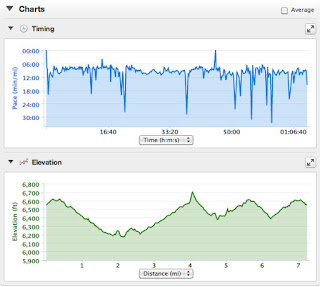
During this 3month process, there's been moving and a new job cutting into my training a bit.  But I finally had a chance to compare my fitness a little (albeit unscientifically).  I was in Florida for business and I thought, aha - more air pressure, NO hills I should blaze through a run.  Then, the heat+humidity had a different plan for me :).  But I was able to maintain a zone 2,3 run at my 6month ago marathon pace for ~7miles.  Good sign as it was relatively easy.  Then after 5 days in FL, back to colorado on the relatively flat trails behind my house.  Let's compare my performance. (same runner, same shoes, days apart, same relative perceived effort (RPE))

Colorado:
Distance: 7.45 miles
Pace: 9:41 / mile
Cumulative Elevation Ascent:  1600 feet
Temp/Humidity: 79 F / 23 %


Florida:
Distance: 8.61 miles
Pace: 7:19 / mile
Cumulative Elevation Ascent:  25 feet
Temp/Humidity: 82 F / 80 %


Heat is a big factor, but running uphill is bigger!  

Now on to the fact/fiction from Active.com:

Outdoors
Many athletes use altitude-training programs to enhance their physical performance. However, utilizing these concepts for fitness purposes can be a little tricky. Here are some of the common thoughts, right or wrong, regarding high-altitude training and how it can help or hurt you in your fitness pursuits.

Training at altitude is beneficial because the air is thinner.

FICTION
It’s not the lack of oxygen that makes your body work so hard at altitude. It really has to do with the barometric pressure. Even at 10,000 feet, there is still 29 percent oxygen in the air, and out of that 29 percent you only take in around 10 percent of the oxygen you breathe. The big challenge is your ability at altitude to extract the oxygen and get it into your bloodstream at altitude.

More
The Effects of High-Altitude Training
At sea level, your body uses air pressure to its advantage. It allows all of the weight from the atmosphere to help push the air into your lungs, moving the air from an area of greater pressure to lower pressure.
The same happens at a cellular level, where the pressure then allows the air (including oxygen) to be pressed into your bloodstream.
When you work at a place that is higher than sea level, you start to experience less barometric pressure. Thus the air is not forced into the bloodstream as easily, making the body work harder.
Over time, the body will grow more red blood cells to help ease the struggle of getting oxygen. These cells help carry oxygen through the body, which will result in better fitness/sports performance.

Training at altitude will make me more fit.

FACT
Professional and Olympic athletes have known the benefits of altitude training for years. After all, there is an Olympic Training Center in Colorado Springs, Colorado, for a very good reason. If someone trains at altitude, they will see improvements in their maximal oxygen uptake (the ability to take oxygen in and move it into the blood stream), increased lactate threshold (the ability of the body to get over the “burn”), improved power output, and better sleep (which helps repair the body). These benefits are all a result of the red blood cell production caused by the adaptation to low-barometric pressure.

If I train with a mask that restricts airflow, it will simulate training at altitude.

FICTION
As stated before, the benefits of altitude training are not found from areas that lack oxygen, but from areas of lower-barometric pressure. Restricting airflow does not simulate training in altitude. In fact, training with reduced oxygen can cause serious problems like hyperventilation, disorientation, rapid heartbeat, elevated blood pressure and loss of consciousness.
Better use of altitude training would be sleeping in a hyperbaric tent. These tents create an enclosed, simulated altitude that allows the body to see results of altitude training while residing at sea level. These tents can be purchased or rented and assembled in your own bed. Some places offer hyperbaric chambers that you can visit for a fee. The “altitude” is adjusted slowly as the body adapts, and it has been proven to yield positive results.
Though air-restrictive masks may prove beneficial for some athletes whose sport requires working with low-oxygen levels, the masks pose danger to those using them to "get fit.”

If I train at altitude, then race at sea level, I’ll see better performance.

FACT
Well, this is a tricky one. Depending on the environment, it could backfire on you. If you spend time training in Colorado, which is high and very dry, then do a marathon in Florida, which is low and very wet; you may experience some problems because of the humidity. However, generally, you should see better times, strength and recovery if you train at altitude (or simulated altitude), and then perform at sea level.

If I train at sea level and plan to do a race in the mountains, then it’s probably a good idea to get there a few days early to prepare for the race.

FICTION
When you’re not accustomed to altitude, you have two choices: do the race immediately—within a day—or wait 7 to 10 days before racing. If you get to an event a couple of days before, your body has time to figure out that you are in a different environment, and then it will start making the necessary changes it needs to survive at altitude. Your body will become stressed, and then it will show in your performance.
If you do the event immediately, it will not have time to start adapting, and you should not see terrible challenges to your pulmonary system. If you get there 10 days ahead of time, your body will have plenty of time to fully acclimate.

Friday, April 12, 2013

The Roseto effect - know your neighbors


We're healthy people.  We concern ourselves with exercise, diet,... things we do to mimic our ancestor, take advantage of our adaptations.  But you can eat right and exercise, and run like the persistence hunters we evolved to be and STILL miss the boat.  

Healthy social aspects are needed for humans' longevity.  We are MORE community-oriented than you'd think.  In a time where noone knows their neighbors and people are sicker than ever (or require more medical intervention than ever).

The town of Roseta, PA had remarkably less non-infectious diseases and long life spans than any other neighboring towns with same diet and other factors.  Roseta had a social structure that mimicked ancestral cohesion and when that was gone, their mortality rates matched their PA peers.

From the piece:

This remarkable pattern suggests systematic differences between the two neighboring communities over the course of at least 30 years-years for which there are many indicators of greater social solidarity and homogeneity in Roseto and no evidence of differences in coronary risk factors.15 The social changes that occurred in Roseto in the 1960s are reflected in sharply increased rates of heart attack among men under the age of 65.

Executive Summary:  

The Roseto effect: a 50-year comparison of mortality rates.


OBJECTIVES. Earlier studies found striking differences in mortality from myocardial infarction between Roseto, a homogeneous Italian-American community in Pennsylvania, and other nearby towns between 1955 and 1965. These differences disappeared as Roseto became more "Americanized" in the 1960s. The present study extended the comparison over a longer period of time to test the hypothesis that the findings from this period were not due to random fluctuations in small communities. 

METHODS. We examined death certificates for Roseto and Bangor from 1935 to 1985. Age-standardized death rates and mortality ratios were computed for each decade. 

RESULTS. Rosetans had a lower mortality rate from myocardial infarction over the course of the first 30 years, but it rose to the level of Bangor's following a period of erosion of traditionally cohesive family and community relationships. This mortality-rate increase involved mainly younger Rosetan men and elderly women. 

CONCLUSIONS. The data confirmed the existence of consistent mortality differences between Roseto and Bangor during a time when there were many indicators of greater social solidarity and homogeneity in Roseto.

Sunday, April 7, 2013

First Real Run in B2R Trail Shoes


Using the new B2R Trail Shoes:
 photo 983D4EF4-AF3B-4B5A-B3DF-B46D330B0803-9413-000005F3D938B539_zps3aa34565.jpg
I see these peaks out of my kitchen window:  (peak on the left index finger, smaller summit with a house on it, then the top of the Incline Trail.)
 photo FA408E19-5A6A-4C48-9FBC-04380B10D7FD-9454-000005F4ADE2693E_zps77dfab5d.jpg

So I make it up to that First Peak: (looking down at my house)


Then I run to that house on the shorter peak.  Most of the time I feel like i'm following a trail, but I keep losing it.  I eventually end up on a driveway, I zig zag that dirt road for a while, finally just bound / bushwhack down a loose gravel/dirt hill, run on a paved road until I find another dirt trail!  Then I head to a geometrical shape I see on a neighboring peak.  Looks like a pill box or something.  Along the way I find a lantern, seems old.  The 'pill box' turns out to be a torn down house's foundation.  And after visiting it, I see it's the 'end' of the red mountain trail.


The shoes did GREAT.  I have not taken them through water crossings yet.  but the way the dust sifts through, you can tell they will drain quickly (and therefore dry quickly).

 photo 8A676C11-5317-4587-9E42-166392DB150E-9454-000005F486931951_zps6eaaaca5.jpg

I did have to stop a couple times to pull out cactus needles from my foot.

Sunday, March 31, 2013

Members of Gaited Community, Jason P.


I notice that we always get stories (and books) about the most elite athletes, but how many of us middle-of-the-packers can relate to their stories.  For example, Scott Jurek's stories about running in the dark during an ultra with your headlamp off to sneak up on the runner you want to pass - then at the last moment turning on your light and blaze past so you can crush their spirits.  To most of us, the leaders are in a different orbit.  Most of us are chipping away at our personal bests and deriving much pleasure in the process.  This led me to ask some runners I admire to answer a few interview-style questions.  Their stories will hopefully inspire others as they have inspired me!

Cheers to our first member of the Gaited Community.  I met Jason (featured below) on the DC Metro at 5:30am en route to my first marathon.  I was totally unprepared and about to hurt myself.  Jason seemed so calm and ready to (actually) race it!  He talked me into going with coaching to get better prepared.  I owe him big time for that, and introducing me to 'Born To Run's Eric Orton (www.runningwitheric.com).  A few years ago, Jason started out with >2hour half marathon - got stronger, faster, smarter - today he's preparing for the 2013 Boston Marathon, where he'll likely break 3hours (sub 7 min/ mile for 26.2 miles!).  

*Note, I've been chasing him for a while, I frequently joke that me getting faster/better helps encourage him to improve.  Well, something's working!  GO Jason!!

> Why did you start running?
About 2005, I started running because I needed to lose weight. I had run very little growing up or playing any sports. I was 190 lbs and I needed to do something about that. I did very little running and signed up for my first 5k, Washington DC's race for the cure. I remember running for 15 minutes max at a time and never doing more than 3 days a week. I ran that race and expected to run with 10 min per mile pace. I ended up running my first 5k at 25:55 at an 8:20 pace much faster than I thought. I loved it. I loved running with people, I loved the competition and I loved pushing myself. The very next day, I signed up for the Baltimore half marathon and pieced together a training plan from runner’s world. I loved running but didn’t really begin doing it daily until the winter of 2005. When a personal situation forced me to reevaluate my life, I began running daily. I lost weight and started getting faster. My first marathon was in 2006 and since not a year has gone by without at least a marathon.  
> What were your first runs like?
Horrible. I hated it. I had old new balance shoes that I bought for fashion and ran in. I had no idea what shoes to buy, how fast to run, or what to run in. I ran in army fatigue cut offs and cotton t shirts.  I sweated so much, I had no idea what to do. But when I raced, it felt so freeing.
> What was your most memorable run so far and why?
JFK 50. Until this race, I had never believed in the runners high. But at mile 42 I was so happy and delirious. I was slapping people’s backs and yelling that we were going to finish. I had no idea how I was going to do and to finish in the top 100 was a big deal for me.
>Note, top 100 is better than 10% finisher.  That is the oldest, biggest Ultra in the country, so that's saying something!!  


> Do you do other fitness related activity? If so, what?
I do core. I enjoy biking, canoeing and hiking. If I could kayak everyday, I would. I enjoyed rock climbing in the past, but I rarely do anything besides run.
> What has kept you running?
Love. I truly believe it is the only sport that I practice every day and see growth. I love because I need no equipment besides my body and shoes. I don’t need a weight or a bike. It is all about me.
> What is your next running goal or milestone?
Run a sub 3 marathon. Finish a 100 miler. Become more efficient trail runner.
> Have you seen any improvement to your health that can be attributed to running? If so, please explain.
Lowering of my HR and weight.
> What has been your worst running experience so far?
Just feeling the doubt of myself. I have run races where I start doubting myself and my ability. This has led to some bad races and a few DNFs. I regret those but I am glad to have learned.
> What advice do you have for new runners?
Don’t believe that every run needs to be run at a break neck speed. In fact, run slow at first. Force yourself to run slow. If not, it will not be fun or enjoyable. Also remember that you need to be consistent and patient with running. The more consistent you are the less likely running injuries will occur.

Any questions for Jason?  (I pick his brain all the time).  He works as an educator and Cross Country Coach.

-PR

Wednesday, March 27, 2013

Why People Love The Paleo Diet


Personal Theories On Why People Love The Paleo Diet


paleo diet
Have you been following the Paleo diet’s massive success? It’s charted over on Buzzfeed, and it has apparently crushed diets like “gluten free” or “atkins” or “being vegan which I know is not really a diet, I know that” in popularity. The only thing that remains more popular is cupcakes. The diet dictates that you should eat the food eaten by our cavemen ancestors. Their website states:
These foods include fresh meats (preferably grass-produced or free-ranging beef, pork, lamb, poultry, and game meat, if you can get it), fish, seafood, fresh fruits, vegetables, seeds, nuts, and healthful oils (olive, coconut, avocado, macadamia, walnut and flaxseed). Dairy products, cereal grains, legumes, refined sugars and processed foods were not part of our ancestral menu.
I’ve been speculating on why this is so appealing to people, and this is what I’ve got.


Read more: http://www.thegloss.com/2013/03/26/beauty/love-paleo-diet/#ixzz2OlDGp5ws