Tuesday, June 18, 2013

nutrient density sticking to the essentials


Nutrient Density: Sticking To The Essentials – Mathieu Lalonde (AHS12)


I’ve been a big fan of Mathieu Lalonde ever since I saw his Science of Nutrition lecture. Seriously, if you can buy a copy or attend one of these all day affairs, you’re going to come out with a lot of knowledge you didn’t have when you walked in.
So it was with great anticipation that I’ve been awaiting his Ancestral Health Symposium (AHS) 2012 presentation: Nutrient Density: Sticking to the Essentials. Well, it’s finally out, and as with most things Matt Lalonde, it’s well worth watching.
He starts by covering the concept of Nutrient Density in a historical context: A paper by Boyd Eaton and Lauren Cordain on Nutrient Density, NuVal scores (ideologically/politically biased towards plant-based diets), and ANDI Scores (again, artificially biased against meats). Given that all the established models had significant problems, Lalonde decided he would crunch some numbers and make his own, based on a simple formula:
Nutrient Density = (Σ Essential Nutrients Per Serving) / (Weight Per Serving)
I’m going to stop my discussion here to introduce his video. Everything that follows is based on what he talks about. After the video, I’ll continue…
Interesting conclusions:
  • The best nutrient densities for cooked grains are already negative numbers.
  • Raw grains have a better nutrient density than cooked, but alas, we can’t usually eat raw grains.
  • The notion that grains and legumes are amongst the healthiest foods come from an analysis of them in their raw and inedible state. Once you look at their cooked values, they are amongst the worst (from a nutrient density standpoint).
  • Bacon turns out to be some of the most nutrient dense meats (ditch the grease).
  • The lowest scores for beef are where the highest scores for grains started at.
  • Oysters are awesome. (I think bacon wrapped oysters might be a superfood.)
  • Game meat (like Elk, for example) is surprisingly low. I had expected it to have a higher score.
  • Organ meats (excluding tripe, lungs, and some others) are awesome.
Nutrient Density Averages:
CategoryAvg. Nutrient Density ScoresCategoryAvg Nutrient Density/Caloric Weight Scores
1Organ Meats and Oils17.05Organ Meats and Oils0.49
2Herbs and Spices16.78Herbs and Spices0.21
3Nuts and Seeds10.28Nuts and Seeds0.09
4Cacao7.97Legumes (Raw or Cooked Edible)0.02
5Fish and Seafood1.16Fish and Seafood0.02
6Pork0.69Pork0.01
7Beef0.31Beef0.009
8Eggs & Dairy-0.56Cacao-0.001
9Vegetables (Raw & Unprepared)-0.70Lamb, Veal and Wild Game-0.03
10Lamb, Veal and Wild Game-1.19Poultry-0.05
11Poultry-1.71Plant Fats and Oils-0.05
12Legumes (Raw or Cooked Edible)-2.86Animal Fats and Oils-0.07
13Processed Meat-3.10Processed Meat-0.09
14Vegetables (Cooked, Blanched, Canned, Pickled)-4.84Eggs & Dairy-0.10
15Plant Fats and Oils-5.41Refined and Processed Fats and Oils-0.13
16Fruit-5.62Animal Skin and Feet-0.15
17Animal Skin and Feet-6.22Grains and Pseudocereals (Cooked)-0.25
18Grains and Pseudocereals (Cooked)-6.23Grains (Canned)-0.38
19Refined and Processed Fats and Oils-6.43Fruit-0.44
20Animal Fats and Oils-6.88Vegetables (Raw & Unprepared)-0.53
21Grains (Canned)-7.04Processed Fruit-0.54
22Processed Fruit-8.12Vegetables (Cooked, Blanched, Canned, Pickled)-0.74
Ideally, the essential nutrients he uses to calculate nutrient density would be based on the following, but not all data are available. This introduces a bias for and against certain foods that would be nice to have corrected in the future. The data he has available doesn’t distinguish between Vitamin D2 and D3, nor does it distinguish between the various fatty acids. The table below is his proposed model for how to measure Nutrient Density. Data that was not available to him (but that he would like to be used in Nutrient Density) is indicated:
Fatty Acids:
Amino Acids:
Vitamins:
Minerals:

Monday, June 17, 2013

What is your diet like?

More importantly, what do you eat eats?

I use this example all the time (taken from Daphne Miller's 'The Jungle Effect'),
The indigenous Icelandic diet has NO fruits and tiny bits of vegetables   They eat reindeer meat and and gray fish.  So how do they survive with NO vitamin C?  Turns out the reindeer eat the moss along the river beds, and their meat stores to Vit C for them.  any attempt to duplicate their diet must include that exact moss to be as successful.  Feeding those reindeer grains and corn would make their consumers die of scurvy.
That leads to out mantra: "You are what you eat eats" cutting corners with ingredients will hurt nutritional density or increase toxins.

Can you find plants that eat their intended soil nutrients?  Can you find meats that are fed their intended diets?

((note, there's two eggs for sale at my local grocery store a.) chickens fed a vegetarian diet contain 125mg of omega-3 fatty acids b.) chickens that eat everything contain 225mg of omega-3 fatty acids))


Wednesday, May 29, 2013

Low Calorie High Energy, and Other Oxymorons

As an paleorunner and amateur biohacker I notice things.  Recent example, energy is defined by Websters as:

Definition of ENERGY

1
a : dynamic quality <narrative energy>
b : the capacity of acting or being active <intellectualenergy>
c : a usually positive spiritual force <the energy flowing through all people>
2
: vigorous exertion of power : effort <investing time andenergy>
3
: a fundamental entity of nature that is transferred between parts of a system in the production of physical change within the system and usually regarded as the capacity for doing work
4
: usable power (as heat or electricity); also : the resources for producing such power

Most importantly, energy is quantitative, it's measurable.  When it is measured the units are Joules, calories, BTUs, etc depending on the application (like distance is measured in inches, miles, mm, parsecs, depending on the application).  

So the question is how can something be low calorie (the unit of measure of energy) and high energy at the same time?  It is an easy answer, it can't.  Food energy is heat given off through the digestion/respiration of food.  Food is referred to as food energy.  We eat for energy, flavor and fun ;).  

Fats and ethanol have the greatest amount of food energy per mass, 9 and 7 calories/gram, respectively. Proteins and most carbohydrates have about 4 calories/gram (I am using dietary calories here, which are a kilocal). Carbohydrates that are not easily absorbed, such as fiber or lactose in lactose-intolerant individuals, contribute less food energy. Polyols (including sugar alcohols) and organic acids have less than 4 calories/gram.

So you have to eat 2 grams of sugar to get the same amount of energy as 1 gram of fats.  In (overly) simple terms, you need to eat 2 lbs of sugary foods just to make it through the day, but you'd only need to eat 1 lb of fats for the same energy output.  High fat diet means less food.  

Life advice: You need to solve the macronutrient (aka, carbs, proteins, fats) needs before you ever consider micronutrients (vitamins and minerals).

For more on the differences in calories, read:


Monday, May 6, 2013

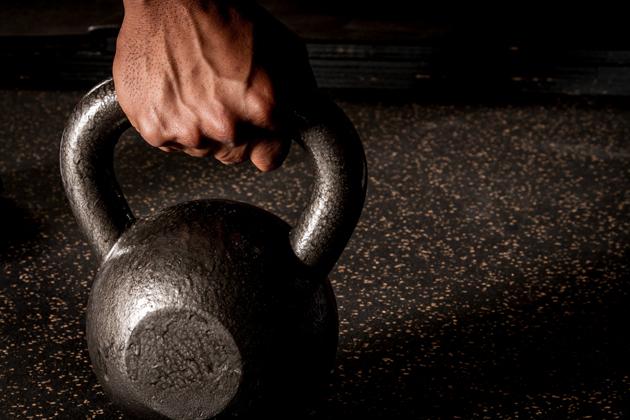
10 Dangerous Kettlebell Mistakes - be smart!


10 Dangerous Kettlebell Mistakes

Before you grab a kettlebell, make sure you’re not risking serious injury.

Mike Stehle, CPT
Whether you’re a new entry to kettlebell training or are an old hand, injuries can still strike at any time if you’re practicing the moves incorrectly. We asked Mike Stehle, owner of Training Room Onlinewhat common mistakes he sees athletes of all experience levels making.

1. Not following proper movement progression

Too many people attempt exercises they and their bodies are not prepared to properly execute.

Area of risk:

The most common area at risk is usually the back. For example: The kettlebell swing shouldn’t be performed until the deadlift is mastered.

How to avoid:

Be patient with your training and progress slowly. Take up sessions with a coach or trainer to develop a solid, progressive plan.

2. Not maintaining a neutral spine

A neutral spine establishes the correct alignment of the athlete. This must be kept in mind when performing swings, high pulls, clean or snatch.

Area of risk:

The entire spine and surrounding musculature.

How to avoid:

Keep a straight line from your hips to your head. You should be able to lay a broomstick along the entire spine.

3. Taking too wide a stance

All stances are not created equal. Overly extended stances during swings leave several areas vulnerable to injury.

Area of risk:

Hips, knees and lower back.

How to avoid:

Take an athletic stance. An athletic stance can be defined as a stance out of which you would jump.

4. Muscling the bell with the upper body

Overemphasis of upper body muscles during ballistic movements deteriorates exercise flow and can place strain on vulnerable areas.

Area of risk:

Neck, shoulders, lower back.

How to avoid:

Relax the upper body, use a hip snap and lock the knees out with each rep.

5. Training to muscle failure

Training to failure with kettlebells is asking for trouble.

Area of risk:

Whatever area you push to failure is at risk. Form will suffer and lead to injury.

How to avoid:

Stop several reps short of failure.

6. Attempting to rescue a bad repetition

If something doesn’t feel right, there’s a good chance it’s not. Stop and put the bell down before paying the price.

Area of risk:

Primarily the lower back.

How to avoid:

Don’t try to force reps. Be conscious of your form and the quality of the reps.

7. Trying to get too fancy

Attempting to invent new movements outside of the basics don’t provide a reward worth the risk.

Area of risk:

Mostly spine, but many things can go wrong when you do wacky things with a kettlebell

How to avoid:

Stick to the basics. They work the best.

8. Using too tight a grip

Death gripping bells are pointless and dangerous with kettlebell ballistic movements.

Area of risk:

Hands and elbows.

How to avoid:

Relax your grip and hold the bell in the hook of the fingers rather than the meat of the hand.

9. Smashing the forearms

Kettlebell cleans and snatches change the bell’s position during a movement—stay in control of the motion so the bell doesn’t fall down and smash into your forearms.

Area of risk:

Lower and upper arms.

How to avoid:

Punch the kettlebell upwards instead of swinging it while relaxing the grip and allowing the bell to gently catch against your forearm.

10. Wearing Improper footwear

Running shoes are for running, not for kettlebells.

Area of risk:

Running shoes raise the heel and can push the knee forward during squats or swing which could possibly contribute to knee injury.

How to avoid:

Train in flat soled shoes or even go barefoot—you’ll be more stable.