Wednesday, January 25, 2012

A Scientific Look at the Dangers of High Heels

Important takeaway:

The risks extend to workouts, when heel wearers abruptly switch to sneakers or other flat shoes. “In a person who wears heels most of her working week,” Dr. Cronin says, the foot and leg positioning in heels “becomes the new default position for the joints and the structures within. Any change to this default setting,” he says, like pulling on Keds or Crocs, constitutes “a novel environment, which could increase injury risk.”
It should be noted, he adds, that in his study, the volunteers “were quite young, average age 25, suggesting that it is not necessary to wear heels for a long time, meaning decades, before adaptations start to occur.”


A Scientific Look at the Dangers of High Heels

Illustration by Henrik Sorensen
Not long ago, Neil J. Cronin, a postdoctoral researcher, and two of his colleagues at the Musculoskeletal Research Program at Griffith University in Queensland, Australia, were having coffee on the university’s campus when they noticed a young woman tottering past in high heels. “She looked quite uncomfortable and unstable,” Dr. Cronin says.
Some observers, particularly women, might have winced in sympathy or, alternatively, wondered where she’d bought stilettos. But the three researchers, men who study the biomechanics of walking, were struck instead by the scientific implications of her passage. “We began to consider what might be happening at the muscle and tendon level” in women who wear heels, Dr. Cronin says.
How shoes affect human gait is a controversial topic these days. The popularity of barefoot running, for instance, has grown in large part because of the belief, still unproven, that wearing modern, well-cushioned running shoes decreases foot strength and proprioception, the sense of how the body is positioned in space, and contributes to running-related injuries.
Whether high heels might likewise affect the wearer’s biomechanics and injury risk has received scant scientific attention, however, even though millions of women wear heels almost every day. So, in one of the first studies of its kind, the Australian scientists recruited nine young women who had worn high heels for at least 40 hours a week for a minimum of two years. The scientists also recruited 10 young women who rarely, if ever, wore heels to serve as controls. The women were in their late teens, 20s or early 30s.

The scientists asked the heel-wearing women to bring their favorite pair of high-heeled shoes to the lab. There, both groups of women were equipped with electrodes to track leg-muscle activity, as well as motion-capture reflective markers. Ultrasound probes measured the length of muscle fibers in their legs.
All of the women strode multiple times along a 26-foot-long walkway that contained a plate to gauge the forces generated as they walked. The control group covered the walkway 10 times while barefoot. The other women walked barefoot 10 times and in their chosen heels 10 times.
It was obvious, as the scientists had suspected watching the woman during their coffee break, that the women habituated to high heels walked differently from those who usually wore flats, even when the heel wearers went barefoot. But the nature and extent of the differences were surprising. In results published last week in The Journal of Applied Physiology, the scientists found that heel wearers moved with shorter, more forceful strides than the control group, their feet perpetually in a flexed, toes-pointed position. This movement pattern continued even when the women kicked off their heels and walked barefoot. As a result, the fibers in their calf muscles had shortened and they put much greater mechanical strain on their calf muscles than the control group did.
In that control group, the women who rarely wore heels, walking primarily involved stretching and stressing their tendons, especially the Achilles tendon. But in the heel wearers, the walking mostly engaged their muscles.
That biomechanical distinction is important, says Dr. Cronin, who is now a researcher at the University of Jyvaskyla in Finland. “Several studies have shown that optimal muscle-tendon efficiency” while walking “occurs when the muscle stays approximately the same length while the tendon lengthens. When the tendon lengthens, it stores elastic energy and later returns it when the foot pushes off the ground. Tendons are more effective springs than muscles,” he continues. So by stretching and straining their already shortened calf muscles, the heel wearers walk less efficiently with or without heels, he says, requiring more energy to cover the same amount of ground as people in flats and probably causing muscle fatigue.
The obvious question raised by the findings, though, is so what? Does it fundamentally matter if a woman’s calf muscle fibers shorten and she neglects her tendons while walking, especially if she loves the looks of her Louboutins?
That question is difficult for a biomechanist to answer, Dr. Cronin admits. Aesthetics are outside the realm of his branch of science. But the risk of injury is not. “We think that the large muscle strains that occur when walking in heels may ultimately increase the likelihood of strain injuries,” he says. (This risk is separate from the chances that a woman, if unfamiliar with heels, may topple sideways and twist an ankle or bruise her self-image, which is an acute injury and happened to me only the one time.)
The risks extend to workouts, when heel wearers abruptly switch to sneakers or other flat shoes. “In a person who wears heels most of her working week,” Dr. Cronin says, the foot and leg positioning in heels “becomes the new default position for the joints and the structures within. Any change to this default setting,” he says, like pulling on Keds or Crocs, constitutes “a novel environment, which could increase injury risk.”
It should be noted, he adds, that in his study, the volunteers “were quite young, average age 25, suggesting that it is not necessary to wear heels for a long time, meaning decades, before adaptations start to occur.”
So, if you do wear heels and are at all concerned about muscle and joint strains, his advice is simple. Try, if possible, to ease back a bit on the towering footwear, he says. Wear high heels maybe “once or twice a week,” he says. And if that’s not practical or desirable, “try to remove the heels whenever possible, such as when you’re sitting at your desk.” The shoes can remain alluring, even nestled beside your feet.

Plantar Pain?

I like the "forget trying to diagnose the condition, instead just fix it"!  As with any injury the key point is to work up the chain and deal with anomalies along the way. 


Monday, January 23, 2012

Stride Rate and what it means

180 isn't a magic number- Stride Rate and what it means


Speed= Stride Rate X Stride length

How do we increase speed:
There seems to be an ingrained belief that stride rate is constant and that to increase speed we simply lengthen the stride. This is a staple teaching in Chi Running for example, but others such as Amby Burfoot in his recent post brough up the same concept.

The general idea that we use stride length to increase speed (via an increased force application, not by reaching out) to a greater degree than stride rate is true. But there becomes a problem when we think in absolutes and limit ourselves to we ONLY see changes in speed with stride length.

We’ve got two different ways to pick up the pace, why limit ourselves to one particular way?

If we look at a previous post of mine that showed how elite 10k runners ran at just below 10k pace and then picked it up during the race, you see clearly, that runners use several different methods to increase speed. Bekele for instance went from running 10k pace to running just faster than mile pace solely by increasing his frequency from 190 to ~216. He did this without a change in stride length. On the other hand, some of the other runners increased speed by lengthening their stride or doing a combo of both. The point is, that the data shows us that to increase speed from 2:45 per kilometer to a sub 60 last lap, athletes employed several different methods. And the method they used was that which they hadn’t relied upon all race (i.e. Bekele had relied on a long stride and “slower” frequency so he increased the frequency).

If we look at some other data from a group of top notch NCAA athletes from UTEP 2-3 years ago, you can see their stride rates and relative stride lengths (a ratio of their height) at a mix of paces (note this is the average for the group so we can’t see how individuals pick up the pace):
Pace ---Stride Rate---Relative stride length
7:40--- 175--- .68
6:43--- 181--- .76
5:58--- 185--- .82
5:22--- 191--- .83
4:58--- 196--- .93
(Data from De Heer, 2008)


For these athletes you go from a very easy pace to about marathon pace or a tad faster, so still not that quick in the big scheme of things. As a whole, their stride rate changed by an average of 21spm to accomplish an increase in stride length.

Lastly, I think it’s important to realize what happens during fatigue. When we tire our ability to produce force quickly starts to fade. Since we aren’t imparting as much force into the ground we do one of a couple options. We either slow down as our stride length diminishes or we compensate. We compensate by increasing stride frequency to take up the slack and maintain or increase speed (remember speed=rate X length, so if length drops, we got to increase rate to maintain the same speed), or we do something to allow us to maintain force production such as increase the range of motion of our arms. (Open up the arms like a sprinter- allows for increased force transmission.)

What’s the point of all this? To show that, yes we do rely on stride length more so proportionally to increase speed, but don’t neglect the role of stride rate. They both change, and to try and hold one constant is not a good idea. We don’t simply increase stride length to change speeds like is often taught.


What the heck is a high stride rate?
The other part of this debate is the notion that everyone should have a high stride rate. That’s the argument coming from several in the running industry. I don’t disagree on the surface that a quicker stride is better compared to what most people do, but how high is a high stride rate?

In several running form publications they tout 180 as the magic number. There is nothing special about 180. It comes from work back in the day when Jack Daniels counted stride rates during competition of elites and found that they all had a stride rate of over 180. People forget the “over” part and they also forget the question of what speed were they running at? As we can see from the data above, speed matters. If we measured the Kenyan Runners warming up at the same pace, they would have been at 175, with some being at 165 and some being at 188 (based on guessed from Standard Deviation data). If we only looked at when they were running a tempo run, then the average is 196, and its almost guaranteed that they are all over 180.
If we go further to faster paces, stride rates get even higher. Elite sprinters like Tyson Gay reach around 300spm when sprinting the 100m. In the Bekele data, he reaches 215 or so for the last 400m. I’ve got data from travelling around watching world class athletes that have guys running 200spm and 220spm roughly at the same 3k pace.

To back this idea up further I took some data from myself as I picked it up from a slow jog 7:30 pace to down to about 5min pace, which is about threshold pace for me at the moment. At 7:30 pace I was around 166, in the mid to high 160’s. At the tempo pace I was 192-198 consistantly.

Which brings us to the current topic of increasing stride rate that everyone seems to be talking about. If we know elites go from anywhere from the 170 range for easy distance pace (~7min/mi) up to 215+ for 3k race pace, what does that mean for the rest of us? Do we copy the elites in having relatively “high” rates even though some recreational runners might be jogging 4+min slower/mi on the distance pace side of things?
Does it make sense for a recreational runner running 10-11min miles to be trying to hit 180spm? Probably not, unless that is a quicker pace for him. Just to do the math, if we had a runner doing 180spm at 11min mile pace, he’d have a stride length of just 32inches!


Then why is everyone in a rage over increasing stride rate? Because as I’ve pointed out before, most recreational runners simply overstride, which artificially creates a very low stride rate. Why? Because the foot lands so far out in front of the Center of Mass that it takes a while for your body to be over it and ready to push off. So, when some running form coach says to increase stride rate to X, what ends up happening is the runner is trying so hard to increase stride rate, he chops his stride a bunch by putting his foot down earlier and landing closer to his center of mass, thus decreasing the overstriding. Nothing particularly wrong with that.

Where we go wrong is in the logic that the stride rate increase is the key. No, it’s not. It’s the elimination of the overstriding. Using the cue to increase stride rate is a way for coaches/runners to reduce the heel striking overstride.

This doesn’t seem like a big deal, until people start taking it to the extremes. That’s when you get the claims of a magic stride rate and the idea that you can NEVER have a low stride rate. Or another bad direction is when you have people who stick to a certain stride rate without variance.

Stride Rate, footstrike, and Ground Reaction Forces
All of this somehow brings us to the excellent post by Jay Discharry on stride rate and GRF/loading rates. To really cover this topic, another post is required, but briefly I’d like to make some points.
I agree with Jay that footstrike isn’t everything. I’ve seen it numerous times where you can have an athlete forefoot or even midfoot strike while still reaching out with their lower leg. We used to call it toe reaching and there was a pretty good elite runner about a decade ago who routinely would fall into that pattern when fatigued. I also agree that it’s quite possible to heel strike with a low impact loading rate if you land close to your center of mass without reaching out. You see this with athletes who have always been taught to dorsiflex like crazy (i.e. Toe up- coaches love yelling that for some reason), instead of just letting the ankle be neutral and do its thing.

The thing to keep in mind though is that it doesn’t mean that footstrike isn’t important. We’re looking at one variable, GRF loading rates, which are important presumably but we still don’t know their exact role. If GRF was all that mattered, great, we could just say land close to your COM and that’s it. Except for the fact that transmission of forces, not just how they load, must play a role. As does putting the foot in position for push off, maximizing elastic energy, etc.

I certainly don’t have all the answers, and the questions regarding foot strike, loading rate, or what have you are very complex. But we’ve got to be careful when focusing on single variables. It’s fun and easy to do and gives us seemingly concrete answers. The problem is when we get into business of tailoring towards single variables, we lose the big picture. You see this in running training when people started to focus on improving single variables like VO2max or Lactate Threshold. Ya, you might improve that, but your making a leap that that one thing is the key to performance and forget the complexity of performance.

The same goes with biomechanics and performance or injury prevention. A single footstrike isn’t the answer. Neither is simply changing stride rate nor simply getting that strike closer to your center of mass. All are pieces two the puzzle. Don’t become obsessive over one and forget the others.

If you really want to minimize loading rates, run really slow with a tiny stride length where your foot barely comes off the ground. It’s simple and it would do the job…but that’s the point, there are more things than just loading rate

For instance, high GRF aren’t all bad. Sprinting is partially dependent on producing high GRF.

What does this all Mean:
In a roundabout kind of way, we get back to the original point of this blog post. Stride Rate is a variable. If you combine it with stride length you get a calculation of speed. It’s very easy to measure, anyone can do it. Because it’s easy to measure, we’ll put more emphasis on it (you don’t see a magic stride length # do you??) I don’t mean that it isn’t a good variable, just don’t give it more meaning than it deserves.

It’s simply one of two ways in which we pick up speed. It’s simple really, turn over faster or lengthen the stride, or some combination of both. Don’t limit yourself to only one of those options artificially.

What I’ve found in my years working on running mechanics and in being taught by some of the best minds on the subject, is that I nor them have ever focused on stride rate or length. Those are outcomes of what you do. They are feedback. They are not things you directly change. If you take care of the mechanics, whether it’s arm swing, body position, force application, footstrike or whatever, the rate and length will optimize. Is it useful to measure length and rate? Sure, but remember that they are data. If one of them seems “off” you’ve got to figure out how to fix it.

Friday, January 20, 2012

Is There a Perfect Human Diet?

We’ve begun blogging at Psychology Today, and I figured I’d start with an introduction to our diet. This is a slightly altered version of our first post there. — Paul
“All healthy persons are alike; each unhealthy person is unhealthy in his own way.”
If Tolstoy were a diet-and-health blogger, this might be how he would begin.

All healthy persons are alike

The composition of cells hasn’t changed much since the origin of complex multi-cellular life about 500 million years. Apart from water, the major components are fatty membranes and proteins. More than half the proteins are glycosylated – bonded to glucose-derived carbohydrates. These compounds – fats, proteins, and glucose – are the basic “macronutrients” needed by cells. In organisms, these cells are supported by an extracellular matrix composed of glycans and proteins; this matrix is mineralized in bones and teeth.
Why do animal species differ in their nutritional needs? Actually, nutrient needs differ remarkably little across the animal kingdom. This is why animals comprise “food” for one another: the ingredients of all animals are the same, so one animal nourishes another.
It is also why breast milk varies little across all mammalian species: the composition of cow’s milk is not much different from the composition of lion milk, for instance – or human milk for that matter.
Human nutrient needs differ from those of other mammals chiefly by virtue of our larger brains, which are rich in omega-3 fats and require extra glucose for energy. But large brains only modestly tweak the needed macronutrients: compared to other mammals, an extra 10-15% of calories as glucose, and an extra 1% of calories as omega-3 fats, are more than sufficient to nourish a human.
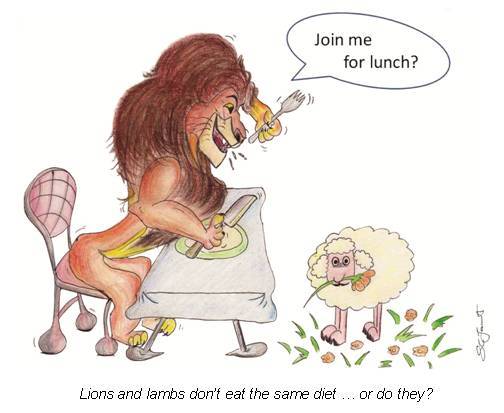
If all animals are alike in their nutrient needs, why are diets so different? Why don’t lions sup with lambs?


It turns out that what differs among the animals is the composition of the digestive tract. Animals have evolved digestive tracts and livers to transform diverse food inputs into the uniform set of nutrients that all need. Herbivores have foregut organs such as rumens or hindgut chambers for fermenting carbohydrates, turning them into fats and volatile acids that can be used to manufacture fats. Carnivores have livers capable of turning protein into glucose and fat.

When we look past the digestive tract at what nutrients are actually delivered to the body, all mammals obtain a remarkably similar set of nutrients. By calories, mammalian diets are always composed of a majority, typically 50-75%, of saturated and monounsaturated fats (including the short-chain fatty acids produced by fermentation of fiber); a mix of carbohydrates and protein, usually totaling around 25-40%; and a modest amount of polyunsaturated fat, typically less than 10%.
If diets differ because of digestive tract differences, we should expect the same pattern to recur in humans. All humans have the same nutrient needs, but our optimal food intake may vary if our digestive tracts differ.
In fact there is evidence for variations in digestive tract structure among human populations. Melissa McEwen has summarized evidence that Africans have slightly larger colons, suggesting a slightly more plant-focused evolutionary diet, and Europeans have slightly smaller colons, suggesting a more animal-focused evolutionary diet [1, 2].
Longer colons allow more fermentation of plant fiber, but they don’t dramatically change macronutrient ratios of the diet. Across human populations, the optimal human diet probably doesn’t vary in any macronutrient by more than 5% of energy or so.
So there is little support for a “blood type diet” or “metabolic type” with significantly different food needs. All healthy people can and should eat a similar diet – one that approximates to our body’s nutrient needs.

Each Unhealthy Person is Unhealthy in his Own Way

What are the causes of ill health? We believe there are three fundamental causes of ill health: malnutrition, toxins, and infectious pathogens.
There are dozens of elemental nutrients – vitamins, minerals, and biological compounds – whose absence in the diet can impair health. Many thousands of toxins, totaling several grams in weight daily, enter the human body; as Bruce Ames and Lois Gold have shown [3], plants make a host of natural food toxins, and food storage and cooking create more. Finally, we are continually exposed to microbes; there are probably hundreds of pathogens capable of establishing human infections.
It doesn’t take a mathematician to see that there myriad possible combinations of malnutrition, poisoning, and infection. The causes of disease are legion; it’s no surprise that the manifestations are so various. The number of possible combinations of disease causes is more than the number of humans. To a first approximation, every disease is unique.
Each combination of causes will affect the optimal diet in a different way. People who are malnourished will benefit from getting more of the things they are malnourished in, and perhaps less of others which balance those – as reducing zinc may help someone who is copper deficient, or reducing omega-6 fats may help someone who is omega-3 deficient. People exposed to toxins may benefit from an extra dose of toxin-metabolizing nutrients. People with infections may benefit from diets which starve pathogens of needed nutrients, or which support immune function. People with gut dysbioses may benefit from removing or reducing whole classes of foods – starches, fructose, FODMAPs, fiber, even protein.
Infections can make a big difference in the optimal diet. Ketogenic diets, which starve the brain of glucose but feed it with small molecules derived from fats, are highly effective against bacterial infections of the central nervous system, since bacteria depend on glucose metabolism. But hepatitis B and C viruses can utilize the process of gluconeogenesis – manufacture of glucose from protein – for their own benefit, so people with hepatitis benefit from higher carb diets.
Other pathologies disrupt the ability to handle certain nutrients. Diabetes is characterized by an inability to secrete insulin, and diabetics usually benefit from low-carb diets. Migraines, like epilepsy, may be caused by genetic or other impairments to brain glucose metabolism, and can often be cured by ketogenic diets, as several of our readers have discovered.
With ill health, the optimal diet often changes. Sick people often have to tweak their diet, and the nature of the change varies with the nature of the pathology.

Diet Can Be a Diagnostic and Therapeutic Tool

Precisely for this reason, diet and nutrition have a valuable place in the healer’s arsenal. A sick person’s response to dietary changes can be informative about the nature of his pathology.
For instance, ketogenic diets are therapeutic for bacterial and viral infections, but can feed protozoa, fungi, and worms (which have mitochondria and can metabolize ketones). Response to a ketogenic diet can help expose the nature of an infectious pathogen.
Because neurons are dependent on glucose or ketones for energy, any pathology which disrupts glucose utilization will cause neuronal starvation, and neurological and psychological distress, which can be relieved by provision of ketones. A well-designed, nourishing ketogenic diet may often ameliorate psychiatric and neurologic disorders.
Dietary tactics can help prevent as well as treat disease. For instance, fasting upregulates autophagy (“self-eating”), the cellular mechanism for recycling damaged or unnecessary components. But autophagy is a central part of the innate immune system; it is how cells destroy invading microbes. Intermittent fasting as a regular practice helps keep the body infection-free, and during intracellular infections refraining from food is often a helpful strategy.
For some pathogens, on the other hand, providing the immune system with plenty of food is usually a better strategy. “Feed a cold, starve a fever” – or is it the other way around? Your body will usually tell you what to do, suppressing or promoting hunger as needed.

Conclusion

There is no one diet that is perfect for everyone, but that is mainly because not everyone is healthy.
Fortunately, healthy people are generally alike in their dietary requirements. We can identify a diet that is very good for nearly everyone, and can tweak that diet in various ways to help diagnose and heal diseases. That is the goal of our book, Perfect Health Diet, and of this blog.

References

[1] Katsarski M, Singh U. [Anatomical characteristics of the sigmoid intestine and their relationship to sigmoid volvulus among the population of Uganda and the city of Plovdiv, Bulgaria]. Khirurgiia (Sofiia). 1977;30(2):159-63. http://pmid.us/916568.
[2] Madiba TE, Haffajee MR. Sigmoid colon morphology in the population groups of Durban, South Africa, with special reference to sigmoid volvulus. Clin Anat. 2011 May;24(4):441-53. http://pmid.us/21480385.
[3] Ames BN, Gold LS. Paracelsus to parascience: the environmental cancer distraction. Mutation Research 2000 Jan 17; 447(1):3-13. http://pmid.us/10686303.

Heart Disease / Cholesterol

Heart Disease / Cholesterol <from Chris Kresser .com>

single eggFor the last half century, the medical establishment has vigorously promoted the notion that high cholesterol is a primary risk factor for coronary heart disease, and that a diet high in saturated fat and cholesterol causes heart disease. These hypotheses are widely accepted as fact by many physicians and the general public alike, despite the overwhelming body of evidence that suggests otherwise.
In the following articles, I <Chris Kresser> review over fifty years of research demonstrating that:
  1. High cholesterol is not the primary cause of heart disease.
  2. Diets high in saturated fat and cholesterol don’t cause heart disease.
  3. Consumption of so-called “heart healthy” vegetable oils is linked to heart disease, cancer and many other conditions.
  4. Statin drugs don’t reduce the risk of death for most people, and have dangerous side effects and complications.
I <Chris Kresser> also discuss the latest theories on what causes heart disease and a truly “heart healthy” approach to diet and lifestyle that is supported by both modern science and centuries of traditional wisdom.

Articles

Videos

Offsite Articles

Websites

Books

Handouts from cholesterol talk

Thursday, January 19, 2012

Muscle mass with age

Doomed to lose muscle with age?  These images show what a 40y.o. athlete's leg looks like.  But 'HEALTH' is fitness over age.  Can we maintain muscle mass over age like we had in our 'youthful' 40s? 

You tell me::

A new study called, "Chronic Exercise Preserves Lean Muscle Mass in Masters Athletes," which you can read HERE graphically illustrates what happens to your muscles (with and without) the type of regular and beneficial exercise that the sport of triathlon provides.

The image above is a cross section of a 40-year-old triathletes legs and the associated muscle. But the two images below are the really interesting and telling ones.

40-year-old Triathlete

49tri

At 74-years old...these are your legs on triathlon & these are your legs without triathlon

74-year-old Sedentary Man

74sed

74-year-old Triathlete

74tri


As you can tell, the 74-year-old masters triathletes legs are not unlike that of the 40-year-old triathletes legs. The study's authors go on to write:

"It is commonly believed that with aging comes an inevitable decline from vitality to frailty. This includes feeling weak and often the loss of independence. These declines may have more to do with lifestyle choices, including sedentary living and poor nutrition, than the absolute potential of musculoskeletal aging.
In this study, we sought to eliminate the confounding variables of sedentary living and muscle disuse, and answer the question of what really happens to our muscles as we age if we are chronically active. This study and those discussed here show that we are capable of preserving both muscle mass and strength with lifelong physical activity."
They conclude by writing:

"The loss of lean muscle mass and the resulting subjective and objective weakness experienced with sedentary aging imposes significant but modifiable personal, societal, and economic burdens. As sports medicine clinicians, we must encourage people to become or remain active at all ages. This study, and those reviewed here, document the possibility to maintain muscle mass and strength across the ages via simple lifestyle changes."

Wednesday, January 18, 2012

caveman diet in the NFL


I recently got the 'paleo for athletes' by Loren Cordain - I read that he's learned so much since 2005 that a rewrite is due out soon (he's earned much since then and he's elastic enough to make updates!). 
 Below is a cool dialogue how NFL players are comparing nutrition advice. It is surprisingly common how people are fit despite what they eat.  Since fitness naturally declines with age - it is 'health' that defines that decline.  Poor nutrition will manifest itself in your performance.  I sense some good paleo-diet testimonials coming out as it relates to athleticism and health...


'Caveman Diet' growing followers


By Adam Watson
Special to Page 2
Archive
There are plenty of guys in the NFL who are roughly 6-foot-6 and 300 pounds. But it was the fact that John Welbourn had 8 percent body fat that made the New England Patriots' locker room take notice.
"When I was in New England [during the '08 preseason] a bunch of the guys saw the way I ate and asked a lot of questions. So I ended up writing out some diet stuff for them," Welbourn said. "They were pretty interested."
As they should be.
Welbourn, a 10-year NFL veteran, had just introduced them to the Paleo Diet, more popularly referred to as the "Caveman Diet." But don't let the catchy name fool you -- there's plenty of science behind it.
[+] EnlargeJohn Welbourn
AP Photo/Steven SenneFormer NFL player John Welbourn loves the 'Caveman Diet'.
Loren Cordain has been studying evolutionary nutrition for two decades. He is a professor at Colorado State University and the author of two books on the subject. The idea is that for 99.6 percent of our evolutionary history (2.6 million to 10,000 years ago) we ate virtually the same things and therefore our genome is perfectly adapted to those foods: lean meats, seafood, vegetables, fruits and nuts.
"We've uncovered the diet that humanity evolved with [during the Paleolithic era]," Cordain said. "And that's why it does work because it's consistent with our genes."
The Paleo Diet does not include cereal grains, legumes, dairy, vegetable oils, salt, alcohol or refined sugars. Processed foods are the No. 1 enemy. Followers say if it's got more than one ingredient, it's not in the Paleo Diet. There just haven't been enough generations since the agricultural revolution for our bodies to adapt to the dramatic changes to the human diet.
Welbourn was figuring that out on his own long before he met Cordain.
"I sort of naturally found the diet in that I knew a lot of grains and white sugars and processed foods made me feel sick. I never really cared to eat them," Welbourn said. "I didn't really know a name for what the diet was until about three years ago. It instantly made sense to me since I'd always gravitated that way."
But not everyone who encountered the diet took to it immediately.
In fact, even after Cordain published "The Paleo Diet" in 2002, he had trouble convincing some of his closest friends that it would work for everyone.
One of those people was Joe Friel, who holds a master's degree in exercise science and is a USA Triathlon and USA Cycling certified elite-level coach. He is also a founder and past Chairman of the USA Triathlon National Coaching Commission.
"Essentially I argued [with Cordain] that it wouldn't work for athletes. One day he said to me why don't you try it and see if it works for you or doesn't work for you," Friel said. "So I took the challenge, and for one month ate his recommendations and after about three weeks, I began to realize that I was feeling better and training better than I had in a long time."
With that success, Cordain had found his co-author for a second book, "The Paleo Diet for Athletes," which they published in 2005. But the concept just wasn't ready to catch on.
Until now.
Five years after it was first published, "The Paleo Diet for Athletes" is currently No. 2 on Amazon.com for sports training and sports coaching books. Cordain says most diet books fade in popularity, but this one won't go away. He doesn't know exactly how many people follow the diet, but estimates it to be in the millions.
Welbourn, who now owns CrossFit Balboa in Costa Mesa, Calif., says the explanation is simple.
"I think the biggest reason the book is selling is because it's kind of the time for it," Welbourn said. "People are starting to realize that the way we've been told to eat for the past 40 or 60 years is just plain wrong."
Welbourn said he believes so strongly in the diet that he has founded his own company, Paleo Brands, with Cordain serving as an adviser. Welbourn says the venture grew out of his personal needs. He travels a lot for training and speaking engagements and was having a difficult time finding the necessary foods on the road.
"You wouldn't think finding meat, fruit and veggies would be hard, but it's damn hard in a lot of places, especially airports," Welbourn said. "The biggest complaint about the Paleo Diet is 'Yeah, we know we should eat like this, but it's not convenient for me.' America is based on convenience and we're just trying to make the Paleo Diet more accessible."
Welbourn isn't sure how many of his old Patriots teammates have stuck with the Paleo Diet since he introduced them to it two years ago, but he says he's always trying to pass along what he's learned.
He's constantly going back and forth with Atlanta Falcons tight end Tony Gonzalez, a longtime friend and nutrition fanatic. Gonzalez swears by pasta, whole wheat and other carbs. Welbourn keeps sending him research on the Paleo Diet and hopes to one day convert him.
"Do enough guys eat like this in the football community? I don't know. I still remember on Fridays after practice coming out and seeing huge pizzas," Welbourn said. "I think it'll take a little longer to catch on [in the NFL]. But the sooner people adopt the diet, the sooner they'll see the benefits."

Tuesday, January 17, 2012

Paleo Magazine - through iTunes


Paleo Magazine

By Paleo Magazine

Open iTunes to buy and download apps.

Description

"Paleo magazine is dedicated to giving people the tools and information they need to make the best personal choices for living the Paleo lifestyle. Our goal is to help the millions of people on a SAD (Standard American Diet) diet by giving them information about how the Paleo diet can be a healthier option for them, while providing ideas and support to those who have already embraced it.
Each issue is packed with information on diet, exercise, daily living, recipes, reviews, the latest research, raising Paleo kids and much more!"


*Back issues and future issues are available for purchase within the App.
Future issues are also available through the following auto-renewing subscription:

-6 Issues (12 Months) at £10.49 / $14.99

The subscription will include the current issue if you do not already own it and subsequently published future issues. Payment will be charged to your iTunes Account at confirmation of purchase. This subscription will automatically renew unless auto-renew is turned off at least 24-hours before the end of the current period, your account will be charged for renewal within 24-hours prior to the end of the current period. The cost of the renewal will match the initial subscription price.

You may turn off auto-renewing subscriptions by going to your user’s Account Settings after purchase. No cancellation of the current subscription is allowed during your active subscription period. Please find our Terms and Conditions and Privacy Policy here: http://www.pixelmags.com/t+c/1.0.1/
...More

Screenshots

View In iTunes
This app is designed for both iPhone and iPad
  • Free
  • Category: Health & Fitness
  • Released: 14 January 2012
  • Version: 2.2.5
  • Size: 5.5 MB
  • Language: English
  • Developer: Paleo Magazine, LLC
Requirements: Compatible with iPhone, iPod touch and iPad.Requires iOS 4.0 or later.

Customer Ratings

We have not received enough ratings to display an average for the current version of this application.

30 Things to Stop Doing to Yourself


This is a little different than the typical things I post about.  But it's all about health, right?  A healthy mind is necessary to achieve any goals you have whether they be family, professional, physical, etc...  Remember the analogy, when on an airplane you're told to affix your own oxygen mask first before your child's or anyone else's that may need you.  Fix yourself so you're in a better  position to help others - see below for the 30 things to stop doing to yourself!     
30 Things to Stop Doing to Yourself
When you stop chasing the wrong things you give
the right things a chance to catch you.
As Maria Robinson once said, “Nobody can go back and start a new beginning, but anyone can start today and make a new ending.”  Nothing could be closer to the truth.  But before you can begin this process of transformation you have to stop doing the things that have been holding you back.
Here are some ideas to get you started:
  1. Stop spending time with the wrong people. – Life is too short to spend time with people who suck the happiness out of you.  If someone wants you in their life, they’ll make room for you.  You shouldn’t have to fight for a spot.  Never, ever insist yourself to someone who continuously overlooks your worth.  And remember, it’s not the people that stand by your side when you’re at your best, but the ones who stand beside you when you’re at your worst that are your true friends.
  2. Stop running from your problems. – Face them head on.  No, it won’t be easy.  There is no person in the world capable of flawlessly handling every punch thrown at them.  We aren’t supposed to be able to instantly solve problems.  That’s not how we’re made.  In fact, we’re made to get upset, sad, hurt, stumble and fall.  Because that’s the whole purpose of living – to face problems, learn, adapt, and solve them over the course of time.  This is what ultimately molds us into the person we become.
  3. Stop lying to yourself. – You can lie to anyone else in the world, but you can’t lie to yourself.  Our lives improve only when we take chances, and the first and most difficult chance we can take is to be honest with ourselves.  Read The Road Less Traveled.
  4. Stop putting your own needs on the back burner. – The most painful thing is losing yourself in the process of loving someone too much, and forgetting that you are special too.  Yes, help others; but help yourself too.  If there was ever a moment to follow your passion and do something that matters to you, that moment is now.
  5. Stop trying to be someone you’re not. – One of the greatest challenges in life is being yourself in a world that’s trying to make you likeeveryone else.  Someone will always be prettier, someone will always be smarter, someone will always be younger, but they will never be you.  Don’t change so people will like you.  Be yourself and the right people will love the real you.
  6. Stop trying to hold onto the past. – You can’t start the next chapter of your life if you keep re-reading your last one.
  7. Stop being scared to make a mistake. – Doing something and getting it wrong is at least ten times more productive than doing nothing.  Every success has a trail of failures behind it, and every failure is leading towards success.  You end up regretting the things you did NOT do far more than the things you did.
  8. Stop berating yourself for old mistakes. – We may love the wrong person and cry about the wrong things, but no matter how things go wrong, one thing is for sure, mistakes help us find the person and things that are right for us.  We all make mistakes, have struggles, and even regret things in our past.  But you are not your mistakes, you are not your struggles, and you are here NOW with the power to shape your day and your future.  Every single thing that has ever happened in your life is preparing you for a moment that is yet to come.
  9. Stop trying to buy happiness. – Many of the things we desire are expensive.  But the truth is, the things that really satisfy us are totally free – love, laughter and working on our passions.
  10. Stop exclusively looking to others for happiness. – If you’re not happy with who you are on the inside, you won’t be happy in a long-term relationship with anyone else either.  You have to create stability in your own life first before you can share it with someone else.  Read Stumbling on Happiness.
  11. Stop being idle. – Don’t think too much or you’ll create a problem that wasn’t even there in the first place.  Evaluate situations and take decisive action.  You cannot change what you refuse to confront.  Making progress involves risk.  Period!  You can’t make it to second base with your foot on first.
  12. Stop thinking you’re not ready. – Nobody ever feels 100% ready when an opportunity arises.  Because most great opportunities in life force us to grow beyond our comfort zones, which means we won’t feel totally comfortable at first.
  13. Stop getting involved in relationships for the wrong reasons. – Relationships must be chosen wisely.  It’s better to be alone than to be in bad company.  There’s no need to rush.  If something is meant to be, it will happen – in the right time, with the right person, and for the best reason. Fall in love when you’re ready, not when you’re lonely.
  14. Stop rejecting new relationships just because old ones didn’t work. – In life you’ll realize that there is a purpose for everyone you meet.  Some will test you, some will use you and some will teach you.  But most importantly, some will bring out the best in you.
  15. Stop trying to compete against everyone else. – Don’t worry about what others are doing better than you.  Concentrate on beating your own records every day.  Success is a battle between YOU and YOURSELF only.
  16. Stop being jealous of others. – Jealousy is the art of counting someone else’s blessings instead of your own.  Ask yourself this:  “What’s something I have that everyone wants?”
  17. Stop complaining and feeling sorry for yourself. – Life’s curveballs are thrown for a reason – to shift your path in a direction that is meant for you.  You may not see or understand everything the moment it happens, and it may be tough.  But reflect back on those negative curveballs thrown at you in the past.  You’ll often see that eventually they led you to a better place, person, state of mind, or situation.  So smile!  Let everyone know that today you are a lot stronger than you were yesterday, and you will be.
  18. Stop holding grudges. – Don’t live your life with hate in your heart.  You will end up hurting yourself more than the people you hate.  Forgiveness is not saying, “What you did to me is okay.”  It is saying, “I’m not going to let what you did to me ruin my happiness forever.”  Forgiveness is the answer… let go, find peace, liberate yourself!  And remember, forgiveness is not just for other people, it’s for you too.  If you must, forgive yourself, move on and try to do better next time.
  19. Stop letting others bring you down to their level. – Refuse to lower your standards to accommodate those who refuse to raise theirs.
  20. Stop wasting time explaining yourself to others. – Your friends don’t need it and your enemies won’t believe it anyway.  Just do what you know in your heart is right.
  21. Stop doing the same things over and over without taking a break. – The time to take a deep breath is when you don’t have time for it.  If you keep doing what you’re doing, you’ll keep getting what you’re getting.  Sometimes you need to distance yourself to see things clearly.
  22. Stop overlooking the beauty of small moments. – Enjoy the little things, because one day you may look back and discover they were the big things.  The best portion of your life will be the small, nameless moments you spend smiling with someone who matters to you.
  23. Stop trying to make things perfect. – The real world doesn’t reward perfectionists, it rewards people who get things done.  Read Getting Things Done.
  24. Stop following the path of least resistance. – Life is not easy, especially when you plan on achieving something worthwhile.  Don’t take the easy way out.  Do something extraordinary.
  25. Stop acting like everything is fine if it isn’t. – It’s okay to fall apart for a little while.  You don’t always have to pretend to be strong, and there is no need to constantly prove that everything is going well.  You shouldn’t be concerned with what other people are thinking either – cry if you need to – it’s healthy to shed your tears.  The sooner you do, the sooner you will be able to smile again.
  26. Stop blaming others for your troubles. – The extent to which you can achieve your dreams depends on the extent to which you take responsibility for your life.  When you blame others for what you’re going through, you deny responsibility – you give others power over that part of your life.
  27. Stop trying to be everything to everyone. – Doing so is impossible, and trying will only burn you out.  But making one person smile CAN change the world.  Maybe not the whole world, but their world.  So narrow your focus.
  28. Stop worrying so much. – Worry will not strip tomorrow of its burdens, it will strip today of its joy.  One way to check if something is worth mulling over is to ask yourself this question: “Will this matter in one year’s time?  Three years?  Five years?”  If not, then it’s not worth worrying about.
  29. Stop focusing on what you don’t want to happen. – Focus on what you do want to happen.  Positive thinking is at the forefront of every great success story.  If you awake every morning with the thought that something wonderful will happen in your life today, and you pay close attention, you’ll often find that you’re right.
  30. Stop being ungrateful. – No matter how good or bad you have it, wake up each day thankful for your life.  Someone somewhere else is desperately fighting for theirs.  Instead of thinking about what you’re missing, try thinking about what you have that everyone else is missing.